African history isn’t boring.
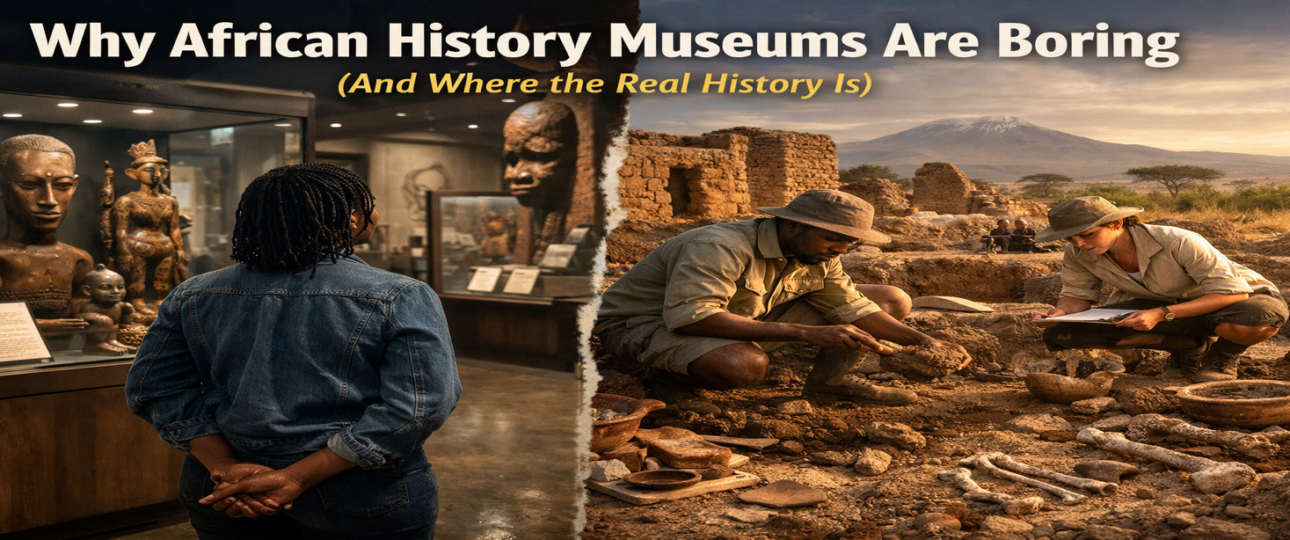
What’s boring is how so many African history museums manage to make it feel like it is – dim halls, hushed guards, and glass cases lined up like coffins for stories that should be shouting, singing, arguing with you.
You step into grand, echoing halls built in another era, past portraits of governors and glass cases of “tribal artifacts,” and you can almost feel the air asking you to behave. The labels are polite. The stories are trimmed. Whole empires of pain and resistance get squeezed into three neat paragraphs.
These museums were designed for officials and foreign visitors, not for you to laugh, rage, cry, or recognize your grandmother’s story on the wall. So you shuffle through, you nod, you leave – and the continent’s wild, beating heart of memory is still out there, alive in places the brochures barely mention.
The “white elephant” museums that were never built for you
A lot of national museums in Africa still feel like you’re walking into somebody else’s house – and that’s not an accident.
In his classic article “Conventional Museums and the Quest for Relevance in Africa,” published in the journal History in Africa, Nigerian archaeologist Ekpo Eyo described how many early museums were seen as “white elephants,” staffed by eccentric colonialists, assisted by Africans “glad of a job,” and visited mainly by foreigners.
A later paper, “Culture, Artifacts and Independent Africa: The Cultural Politics of Museums and Heritage,” by political anthropologist Ciraj Rassool, shows how, even after independence, many institutions simply copied the European model and “failed to make an impact on the lives of Africans” because they didn’t speak to daily realities on the ground.
Rassool notes that they were often located in old colonial administrative districts and perceived as elitist – more comfortable hosting ministers and diplomats than minibus riders and market traders.
You feel that history in the architecture: high steps, heavy doors, guards, a hush that tells you to lower your voice and your expectations. The story inside might be African, but the tone is still colonial.
Instead of stopping at the big white building on the hill, go looking for the small, stubborn spaces that were never meant to be “white elephants” at all – community museums, township cultural centers, people’s archives in modest offices. That’s where history doesn’t whisper; it leans in.
Glass cases, frozen masks – and a continent that moved on
Now follow that feeling into the galleries. Row after row of spears, calabashes, masks. Time seems to stop – and not in a good way.
In an essay hosted by the Museum of UnRest on “The Changing Role of Museums in Africa,” researchers describe how visitors often show “little interest in the displays within the glass cases” unless they see a direct connection to their own heritage. The displays keep circling back to an idea of “traditional life” – rural huts, ritual objects, “tribal” clothing – while skipping the WhatsApp politics, amapiano tracks, matatu graffiti, and city slang that define African lives in 2026.
Art historian Giulia Paoletti, writing in Stedelijk Studies about “Decolonizing the National Museums of Kenya,” notes that colonial collections were documented “in static ways from an outsider’s perspective,” even though African identities are fluid, urban, and shaped by migration and diaspora as much as by village life.
So you get this odd museum Africa: frozen, rural, timeless. Then you step outside into the real thing – loud, layered, remixing itself every afternoon – and they barely look related.
When the blood is edited out of the story
History gets dull the moment the edges are sanded off. Nowhere is that clearer than in how some museums handle colonial violence.
In an analysis for The Conversation, heritage scholar Sarah Van Beurden examined Belgium’s AfricaMuseum and showed how, for decades, it cast Central Africa as a stage for European “civilising missions,” natural history, and exotic curiosities, muting the brutality behind the displays.
Even after a long, much‑publicised renovation, German broadcaster DW reported that diaspora critics still suspected “colonial propaganda 2.0,” because heroic statues and paternalistic imagery remained, while the exhibits historically glossed over the estimated 10 million lives lost under King Leopold II’s Congo Free State.
One Congolese‑Rwandan, Brussels‑based artist, Laura Nsengiyumva, involved in the redesign, told DW that, despite some changes, the museum still “preserves the existing order,” swapping outdated labels for slightly softer language without truly ceding narrative power.
When the numbers – millions dead, entire regions reshaped by rubber quotas and forced labour – get tucked into a paragraph instead of confronted head‑on, the result isn’t neutrality. It’s amnesia. And amnesia is boring.
Tickets, time, and the “worth it” calculation
Then there’s the cost – not just the ticket, but the whole day you trade for it.
The 2022–2023 Annual Report of Iziko Museums of South Africa – the public institution that runs sites like the Iziko Slave Lodge and South African Museum in Cape Town – proudly notes that its museums welcomed 286,551 visitors in that year. That’s a serious number, but when you compare it to Cape Town’s population plus its tourist traffic, it’s relatively modest for a whole network of museums.
Analysts in the same report acknowledge that consumer spending and visitation trends reflect economic hardship and that, for many families, the costs of transport, time off work, and entrance fees sit in tension with more immediate needs. Meanwhile, those same families can experience history and identity for free at religious gatherings, street festivals, protests, football matches, and neighborhood ceremonies – places where culture is lived, not labelled.
Contrast that with the National Museum of African American History and Culture in Washington, DC: the Smithsonian Institution reported that it welcomed over 1 million visitors in just over 4 months after opening and that visitors spend an average of 6 hours inside. Six hours. Nobody does that for a boring story. They do it because the narrative pulls them through pain, pride, music, and resistance in a way that feels worth rearranging their whole day.
Who holds the microphone – and who’s stuck in the frame
Look closely at the labels next time you’re in a big ethnographic museum. Whose voice do you actually hear?
In a widely cited essay on the website Africa Is a Country, historians Bénédicte Savoy and Felwine Sarr discuss how African and diasporic communities remain underrepresented in decision-making, even when the objects come from their families and homelands. One recurring complaint is the lack of transparency around provenance: collections built through military raids, coercive “gifts,” and colonial power imbalances are often presented as if they simply “arrived” in the museum.
In a 2024 dialogue hosted by the South African arts organisation Regartless on “Museums and Decolonisation within the context of Neocolonialism,” participants argued for shifting the museum from a “keeper of culture” to a collaborative space where communities share authority over what is shown and how.
At a “Living Archive” panel, African and diaspora archivists pushed that idea further, saying they want museums and archives to be places where “the people who hold the memories get to define the archive,” instead of being called in only as performers or “consulted communities.” The difference between being a specimen and being a co‑author is the difference between boredom and ignition.
The voices that don’t fit in a display case
If you want Africa’s deepest stories, you’re going to have to sit down with people, not just objects.
Africanist historians working with the International Council of Museums’ Committee for Museums of Ethnography (ICME) have long argued that oral history is central to African historiography because much knowledge was deliberately excluded from written colonial records.
In a paper for ICME titled “Oral History, Museums and Communities,” museum scholar H. Bredekamp asks whether oral history can “make objects speak,” highlighting how African museums imported a European, object‑centric model into societies where memory is carried by storytellers, elders, songs, and rituals.
Newer projects are trying to correct that bias. The African Oral History Archive, supported by organisations such as the African Oral History Association and universities in the United States, is recording interviews with political leaders, activists, and ordinary citizens as primary sources in their own right.
The result is a quiet revolution: a shift from “this pot is from the 19th century” to “this person remembers hiding during a raid, this woman remembers smuggling messages, this trader remembers the first time the border closed.” Those stories rarely fit inside a neat, three‑line caption – which is exactly why you need to go hear them.
The revolution is being archived on Wi‑Fi
While some museum storerooms are still rearranging boxes, young Africans are quietly building digital memory palaces.
At the iPRES 2024 digital preservation conference, a paper titled “Digital Repository for African History, Culture and Heritage: The Keiyo Community Digital Heritage Platform” described how a small community in Kenya is using a digital repository to document its history and culture.
The Keiyo project, supported by local partners and digital‑heritage specialists, is explicitly designed to “bridge the gaps” left by weak paper archives and limited access to mainstream institutions, digitising songs, rituals, and historical narratives that never made it into national museums.
On a broader scale, African Digital Heritage initiatives in Nairobi and beyond are experimenting with community‑controlled archives, 3D documentation, and participatory storytelling to keep data ownership close to the people they represent.
At a “Living Archive” panel on YouTube, archivists and artists from across the continent and diaspora described digitisation not as a tech buzzword but as a survival strategy – a way to stop stories from being lost to damp, neglect, or foreign institutions with better budgets but different priorities.
Youth don’t want to tiptoe through the past
Teenagers and twenty‑somethings aren’t allergic to history. They’re allergic to being treated like they’re one smudge away from being kicked out.
ICCROM – the International Centre for the Study of the Preservation and Restoration of Cultural Property – published a piece literally titled “How can we involve African youth in heritage?” in which experts warn that young people rarely see themselves reflected in museum spaces and call for more digital tools, social media engagement, and youth‑centric programming.
Museum educator Claire Bown, in an article for Thinking Museum on engaging young people, highlights approaches like youth boards, co‑curated shows, and creative labs as key to shaking off the strict, school‑trip vibe. When institutions take that seriously, you can see the difference in the numbers.
In her Stedelijk Studies article, Paoletti describes a participatory exhibition at the National Museums of Kenya – “Who I Am, Who We Are” – that involved artists and communities in exploring identity and displacement and attracted more than 10,000 visitors during its run.
The lesson for a traveler is simple: if the space treats youth as potential vandals, the energy will feel stiff. If it treats them as co‑authors, the air crackles.
Where the sparks really are: shrines, festivals, street corners
More and more scholars are saying the most meaningful “museums” in Africa might not have ticket desks at all.
In a 2024 public conversation organized by Regartless ahead of International Museum Day, titled “Museums and Decolonisation within the context of Neocolonialism,” speakers asked whether traditional cultural spaces – shrines, festivals, monuments, community halls – might actually be better sites for doing history than conventional museum buildings.
They argued for explicitly Afro‑centric approaches that start from local practices of remembrance instead of importing institutional blueprints from Europe. At the same time, the Keiyo History, Culture and Heritage Centre in Kenya and grassroots archives in Nairobi and other cities are documenting history “from below”: everyday life, resistance, migration, and marginalised voices that rarely appear on official timelines.
On that “Living Archive” panel, community archivists described their work as building “living archives” rooted in care, where history is held in relationships and responsibility rather than frozen in someone else’s catalogue.
To experience that as a visitor, you might find yourself at a village festival where drumming and dance retell a migration story, at a community hall where photos of disappeared activists line the walls, or at a roadside shrine that remembers a massacre the guidebooks barely mention.
Proof that when history is told well, people show up
If you’re wondering whether museums can ever get this right, there’s already a proof of concept.
The National Museum of African American History and Culture in Washington, DC, part of the Smithsonian Institution, became one of the most visited museums in the United States almost overnight, welcoming over 1 million visitors in its first four months and averaging about 6 hours per visit.
In a press statement, founding director Lonnie G. Bunch III linked that success to the museum’s commitment to emotionally intense storytelling – from slavery and segregation to Black joy and creativity – using multimedia, personal testimonies, and immersive spaces that people don’t just pass through; they experience.
In Kenya, Paoletti’s research on “Decolonizing the National Museums of Kenya” highlights exhibitions such as “Who I Am, Who We Are,” which turn the museum into a forum for working through identity, displacement, and national cohesion rather than a storage room for artefacts.
So it’s not that “museum” automatically means boring. It’s that some museums are finally willing to lean into pain, conflict, and complexity – and when they do, visitors vote with their time and their feet.
The chapters that never made it to the wall
Even in the best galleries, whole chapters of African history are still missing.
Rassool’s “Culture, Artifacts and Independent Africa” points out how many official heritage narratives tiptoe around the archives of dictatorships, one‑party regimes, and civil wars, even when survivor testimonies and records exist.
Gender scholars working with oral history in Africa note that women’s roles in liberation movements, informal economies, and community leadership are powerfully evident in interviews but rarely appear as central characters in formal displays. Contemporary historians of migration and xenophobia point out that the real documentation of refugees, cross‑border workers, and anti‑migrant violence often lives in NGO reports, activist networks, and community projects, not in national museum galleries.
Environmental memory – land grabs, mining, climate shocks – is likewise being archived through initiatives like the Keiyo digital platform and other activist‑driven projects rather than in tidy cases about “traditional agriculture.”afas.wustl+4
That means that if you only ever walk museum corridors, you’ll miss some of the most urgent stories of the 20th and 21st centuries. But if you’re willing to travel with your eyes open, those stories are everywhere: in murals, in refugee‑run cafes, in community gardens carved out of contested land.
So where’s the real history – and why should you go find it?
Lay everything we’ve talked about side by side, and you get two versions of African history.
There’s the museum version: sanitized timelines, heroic portraits, neat categories, polite labels. And there’s the real‑life version: oral history projects like the African Oral History Archive capturing liberation struggles and everyday survival; digital repositories like the Keiyo platform and other African Digital Heritage collaborations; grassroots memorials and community museums run by neighbourhood groups and faith communities; protest posters, street art, music scenes, and social media threads where people process history in real time.
Organizations like ICCROM and a whole ecosystem of archivists and curators are starting to say it plainly: African history today is being written in WhatsApp chats, YouTube oral histories, community archives, and activist networks – and unless institutions change, they will spend the next decade trying to catch up.
It’s an invitation.
You can still walk through the marble halls if you want. Read the captions. Take the photos.
But then step outside, cross the street, and let the city pull you into its unofficial galleries: the storyteller on a plastic chair under a jacaranda tree, the activist archive in a cramped office, the digital heritage hub in a noisy coworking space, the festival that turns a whole town into a moving exhibit.
If your chest feels a little tight reading this – if there’s a part of you that wants to hear those stories firsthand, to see where memory lives when it isn’t curated – that’s your boarding call.
Pack the notebook. Pack the questions. Pack shoes you can walk miles in.
African history is not waiting quietly in a display case. It’s out there on the street, online, and in someone’s living room – and it’s more than ready for you to show up.