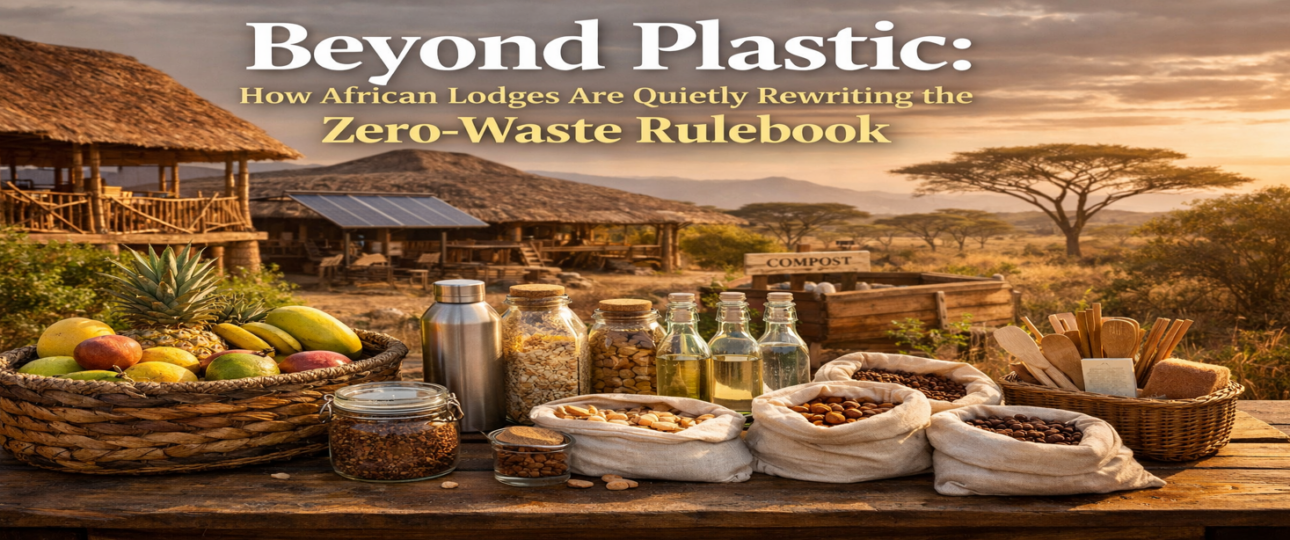
Tourism has always been good at selling sunsets and safaris—and quietly terrible at dealing with the plastic bottle left on the game‑drive seat. For years, the industry’s solution to waste was simple: hide it, burn it, or ship it off to someone else’s backyard.
But across Africa, a very different story is unfolding.
A Continent Where the Bin Is Overflowing
Africa’s tourism is growing fast, which is exciting—more jobs, more visitors, more stories—but also more trash. One recent review of the cleaning and waste industry in Africa says the continent’s waste could almost triple from about 174 million tons in 2016 to roughly 516 million tons a year by 2050. That’s a continent‑sized oops.
Right now, most of that waste doesn’t go into safe, modern landfills. The same review notes that around 90% of it is dumped in open places or burned, and only about 4% is recycled. Another major perspective on waste in Africa is that even when rubbish is collected, more than 90% still ends up being dumped or burned, harming people’s lungs and the climate.
At the same time, a 2025 market study says the waste‑management business in Africa is now worth more than 20 billion dollars and growing, partly because hotels and lodges are under pressure to stop pretending their trash “just disappears.”
Studies on African hotels show that places in South Africa are ahead of many in Ghana or Nigeria when it comes to sorting and recycling, mostly because rules and public awareness are stronger there.
In the middle of all this, African safari lodges are doing something bold: they’re turning remote camps into live experiments in zero‑waste living.
Zero‑Waste in the Wild
Now, imagine trying to manage waste when your nearest town is a distant blur, the roads are rough, and the hyenas are far more reliable than the garbage truck. A study of luxury safari lodges in southern Africa found that the best performers stopped using single‑use plastic bottles and switched to strong, refillable glass bottles and their own water‑filter systems.
They also changed from throw‑away batteries to rechargeable ones. This is not “we put a recycling symbol on the brochure”; this is re‑engineering how water and energy move through the lodge.
Many of these places collect rainwater, clean it on‑site, and fill refillable glass bottles in rooms. Kitchen scraps are turned into compost instead of being burned or dumped. Paper, glass, and metal are separated for recycling. Only a tiny amount remains to be sent to the landfill.
In Cape Town, an airport hotel called Hotel Verde became the first African property to receive official “Net Zero Waste” certification after diverting 93% of its rubbish away from landfill. Including more than 46,000 kilograms of food waste that was composted instead of thrown out.
Hotels and lodges with strong recycling systems have cut their waste‑collection costs by roughly one‑third while increasing recycling rates by about 30%. Proving that “zero‑waste” isn’t just for people who drink green juice—it also makes the finance team smile.
Phinda Private Game Reserve – “It’s Not Me, It’s 11,800 Bottles a Month”
At Phinda Private Game Reserve in South Africa, they basically set plastic bottles down and said, “This relationship is no longer sustainable.” A travel feature on eco‑lodges reports that Phinda has replaced all plastic water bottles with refillable glass bottles and installed its own filtration systems to purify the water.
That simple move stops an estimated 11,800 plastic bottles from being used every single month. If waste could ghost you, this would be it.
The same reporting explains that Phinda didn’t stop at the bar fridge. Lodges there use energy‑efficient air conditioners, LED lighting, and timers on pumps and heaters so machines only work when needed, not just when someone forgot to turn them off.
Plastic, power, and water are treated as one story: fewer deliveries, less packaging, lower energy use, and almost no sense that you’re being “denied” anything as a guest.
You still get your cold drink after a hot game drive; it just doesn’t come with a side order of landfill anxiety.
Angama Mara – The Shamba, the View, and the Vanishing Packaging
Up on Kenya’s Great Rift Valley escarpment, Angama Mara manages to be both deeply glamorous and slightly obsessive about waste. A Forbes‑style profile notes that Angama operates as a plastic‑free lodge and relies on its own garden, called “The Shamba,” to grow much of the fruits, vegetables, and herbs served to guests.
When your lettuce travels meters instead of miles, you cut packaging, fuel use, and the number of sad plastic bags blowing around in the wind.
There’s a money‑with‑a‑soul angle, too. Each guest pays a fixed nightly contribution that goes directly into conservation and community projects in and around the Maasai Mara. So the same system that shrinks the lodge’s food‑and‑packaging footprint also boosts funding for local people and wildlife. Less waste inside the fence means more support outside it.
Cheetah Plains – When the Game Vehicle Purrs Instead of Roars
Cheetah Plains, in South Africa’s famous Sabi Sand reserve, takes the idea even further. The lodge presents itself as the first carbon‑negative safari lodge in Sabi Sand, powered entirely by solar energy and using a fleet of electric game‑viewing vehicles instead of diesel bruisers.
The result? Drives where you hear the crunch of tires on sand, the rustle of grass, and your own pulse quickens at a leopard sighting—without the soundtrack of an engine drowning out the drama.
The lodge’s owner, Japie van Niekerk, has explained that this move was a response to South Africa’s energy and climate challenges, and that they worked with renewable‑energy experts specifically to “set a new standard” for clean safaris.
It’s a bold move in a country still heavily tied to coal, where many hotels rely on noisy backup generators. At Cheetah Plains, guests charge their cameras in the sun, sip filtered water instead of bottled, and go home with more photos than footprints.
Green Safaris – “Silent Safaris” and the Luxury of Hearing Yourself Think
Green Safaris, which runs lodges across Zambia, Malawi, and Botswana, is that overachieving cousin who shows up with solar panels, no plastic, and annoyingly good ideas. The Africa Responsible Tourism Awards highlight that the group powers about 80% of its operations with solar and has eliminated single‑use plastics across its camps, a combination that helped it earn a 2025 “Changemaker” award. That includes places like Ila Safari Lodge and Chisa Busanga Camp, where solar panels and careful design run much of the show.
What really charmed the awards judges was the concept of “Silent Safaris” — game drives in electric vehicles so quiet that guests can hear birds, insects, and the low rumble of elephants instead of a diesel engine. The panel noted that these drives are not only lower-impact but also feel more luxurious, precisely because they swap noise and fumes for intimacy and immersion.
The new flex on safari isn’t how loudly your vehicle roars; it’s how gently it moves through the landscape without waking every creature within a kilometer. The less you disturb, the less you waste.
Hotel Verde – A City Blueprint Bush Lodges Are Quietly Copying
Hotel Verde, near Cape Town’s airport, doesn’t have lions at the waterhole, but it does have something just as valuable: proof that you can run a high‑functioning, almost zero‑waste hotel in the real world of late check‑outs and overflowing buffets.
Cape Town Tourism reports that Hotel Verde became the first African property to achieve official Net Zero Waste certification by diverting 93% of its waste from landfill. The hotel composted more than 46,000 kilograms of food waste and recycled or reused almost everything else.
What makes Verde interesting is not just the result, but the method. The hotel measures its waste carefully, trains staff, and builds systems to make recycling and composting normal parts of daily work. Safari lodges are now taking those same ideas—careful counting, clear rules, and smart design—and adapting them in places where there is no city waste system to lean on.
The city hotel shows what’s possible with spreadsheets and planning; the bush camp proves it can work even when the nearest town is hours away.
Eco Badges With Teeth, Not Just Leaves
Africa isn’t only following global sustainability rules—it’s writing its own. Ecotourism Kenya runs one of the continent’s strongest eco‑certification schemes, grading lodges on waste, water, wildlife, and community impact, rather than letting them slap a green leaf on the website and call it a day.
A 2024 overview of its work notes that smaller, often pricier lodges tend to do more for local communities and are quicker to install solar, wind power, and responsible sewage and waste systems than many big, mass‑market operations.
In busy areas like the Maasai Mara, many camps are now banning the use of firewood and switching to gas or renewable energy, while others are building constructed wetlands—natural systems that use plants and soil to clean wastewater before it returns to the environment. Ecotourism Kenya’s acting CEO, Lynnet Kamonde, has said that “sustainable tourism is about more than conservation… it’s about creating resilient communities and ensuring that tourism benefits everyone,” stressing the need for real partnerships with local people, not just photo ops.
Under this lens, a lodge that has “zero waste” bins but flies in everything in plastic and hires almost no one locally is still wasting something huge: opportunity.
From “Less Bad” to “More Good”
Africa Cleaning Review warns that as hospitality grows, hotels and lodges “must lead the way” with improved recycling and waste management systems, as the projected waste curve is simply too steep to ignore.
The same analysis shows that when businesses set up clear multi‑bin systems with good signage, contamination drops and costs follow—proof that guests are perfectly capable of sorting their trash if you don’t make it a guessing game.
Sustainable tourism trend conversations for 2026, led by African experts, spotlight three big shifts: hard, verifiable data instead of vague claims; genuine community co‑ownership instead of “local” being just a word on the website; and a move from “less bad” to “net positive,” where lodges are expected to actively restore ecosystems and strengthen livelihoods, not just shrink their bin.
Africa Responsible Tourism Awards judges point to Green Safaris’ “Silent Safaris” as proof that low‑waste, low‑noise experiences can actually feel more luxurious, not less.
While some big‑city hotels are still proudly wrapping apples in plastic and calling it hygiene, African lodges are out in the bush running live experiments in how to waste almost nothing, share more with local communities, and still deliver a trip that makes your soul hum.