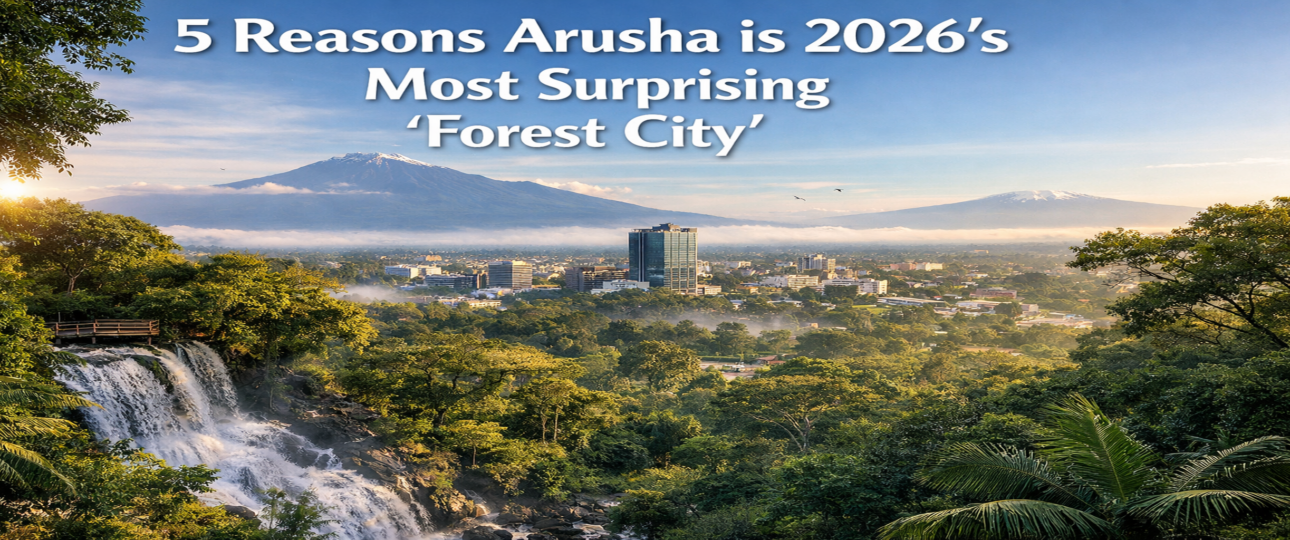
Arusha is the kind of city that doesn’t sit neatly on a map.
It leans. It leans into a volcano, into a national park, into the wind coming off the forests, so that by the time you step out of the bus or the airport shuttle, you’re already somewhere between “city” and “wild.”
If you’re looking for a place where city life and wild landscapes overlap so closely your phone keeps switching between “urban” and “adventure” in the same afternoon, Arusha might be 2026’s most surprising “forest city” – and the one layover you’ll wish you’d stretched into a stay.
A city that shares a fence with a national park
Most cities brag about a central park. Arusha can say, “My local park is 552 square kilometers and has giraffes – and it’s up the road.”
Arusha National Park sits just northeast of the city on the slopes of Mount Meru. The urban area stretches up so close to the park boundary that, in some neighborhoods, “going out of town” means heading straight toward a 552‑square‑kilometer protected area full of montane forest, savanna, crater lakes, and wetlands. It’s a neighbor.
Researchers working with the Wallace Initiative have ranked Arusha National Park among the top 13% of the world’s climate‑resilient protected areas, meaning that even in a harsher, hotter future, it has a good chance of retaining much of its wildlife and forest cover.
They also point out the quiet services that park provides to humans: trees storing carbon, forest canopies cooling the air, wetlands soaking up floodwater, and natural systems filtering water long before it reaches taps or irrigation canals.
You can have breakfast in a city café and be inside a real forest ecosystem before your coffee has fully worn off. You can spend your morning walking under fig trees and your evening eating chipsi mayai in town. Very few cities on the continent blur that line so easily.
Mount Meru’s forest belt: where the city drinks from the mountain
Look up almost anywhere in Arusha and Mount Meru is there – tall, moody, and draped in green.
Tanzania Forest Services describes the Meru‑Usa Nature Forest Reserves as “a paradise of Arusha” – about 8,170 hectares of montane forest wrapped around the mountain’s slopes. It’s a nice phrase, but Arusha National Park’s conservation team gives the blunt job description: this is the city’s “green shield.” Cloud and montane forests here intercept moisture‑heavy winds from the Indian Ocean, keep the microclimate wet and cool, and feed the rivers and waterfalls that run down toward Arusha City and nearby farms.
Park managers report that since 2015, forest cover on Meru’s lower slopes has grown by nearly 8% thanks to reforestation and joint protection efforts by TANAPA and Tanzania Forest Services. More trees mean better habitats for primates and birds, and less silt choking the Momella Lakes. In climate‑anxious years, any graph line pointing up for forest cover feels almost scandalous.
Meru’s presence is part comfort, part drama. The weather changes with the mountain’s mood. Clouds snag on the peaks. Sunlight pours down the slopes in the late afternoon. It’s hard to stay indoors for long.
Micro‑forests in schoolyards and side streets
It’s easy to talk about forests when they come with waterfalls and baboons. The real test is whether the green stuff shows up where kids play, and people queue for vaccines.
A regional study of East African cities notes that places like Arusha have been steadily adding parks and trees as they grow, because urban green spaces soften heat, clean the air, and give wildlife tiny footholds in the concrete. In Arusha, that plays out in schoolyards and clinic courtyards.
In Arusha, some of this gets very practical. In 2022, the Foundation for Environmental Protection in Tanzania ran a tree‑planting campaign that planted 10,000 seedlings across 11 schools, health centers, police stations, local government offices, and households in the Olmot, Terrat, and Muriet wards. Their species list reads like a slow, leafy incantation – Acrocarpus, Delonix regia, Jacaranda, Cedrela, Acacia, Croton.
The Lord Mayor of Arusha didn’t just cut a ribbon and leave. He urged every family to plant at least four trees around their homes, which is basically municipal peer pressure disguised as environmentalism. At the same launch, the foundation’s director reminded residents that trees “make life on earth meaningful” and urged people to plant and protect them.
But that’s how cities change: one tiny promise, repeated across thousands of households.
Safari capital, trying to tread lightly
Of course, once you build a city that rubs shoulders with forests and volcanoes, people will show up. And they have.
Tanzania’s northern safari circuit – Serengeti, Ngorongoro, Kilimanjaro, Arusha National Park, and more – has roared back since the pandemic, with millions of visitors a year and billions of dollars in tourism revenue.
Tanzania hit a record 5.36 million tourists in 2024, beating its own 2025 target early. Arusha, as the unofficial “base camp” for the region, feels that in its bones: more guesthouses, more tour jeeps, more language mixes in hotel lobbies.
Local tour‑operator leaders say they expect visitor numbers to keep climbing, and government targets for tourism income are ambitious. That’s good news for the city’s economy, but also a potential headache for its ecosystems. Conservation voices in Arusha have started saying this out loud: if the city wants its tourism boom to last, it has to sell responsible travel, not just volume.
You can see that tension playing out in Arusha National Park’s own offerings. Instead of only pushing high‑impact game drives, the park markets walking safaris through the forest, canoe trips on quiet lakes, and long, slow birdwatching days.
A small city with surprisingly big green ambitions
Under the jacarandas and the tour buses, people in suits are trying to design a greener future for cities like Arusha before it’s too late.
Tanzania’s urban population has soared from tiny percentages in the 1960s to more than a third today, and projections suggest that nearly half the country will live in cities within the next couple of decades. That puts places like Arusha at a crossroads: sprawl and choke, or grow smarter.
Recent national strategies talk a lot about compact, green cities – the kind where buildings waste less energy, streets stay walkable, and parks and trees are non‑negotiable parts of the plan, not last‑minute decoration.
Green‑building standards have taken off, with tens of thousands of square meters of new floor space certified as more efficient in just a few years. Over 75,000 square meters of floor space in Tanzania were EDGE‑certified between 2024 and 2026, including more than 30,000 square meters at the higher EDGE Advance level.
The Tanzania Green Building Council is pushing architects and developers to design with lower energy and water use in mind.
Global climate and forest organizations have noticed what’s happening in the region. A major partnership led by FAO and other international groups chose Arusha as the host city for a global gathering on “climate‑resilient landscapes” – essentially, how forests, farms, and towns can coexist without destroying each other.
A forest city in progress, not a finished product
Of course, every love story has its cracks.
Conservation groups like Istituto Oikos warn that Mount Meru’s highland forests are “rapidly disappearing” under human pressure – farming, fuelwood collection, and development, even as restoration projects try to stitch them back together.
The Wallace Initiative’s projections suggest that, despite the park’s high resilience ranking, species richness in Arusha National Park could still fall to about 70% of current levels under extreme warming.
Urban researchers also point out that green spaces inside cities can be slowly eaten by informal development and land‑use conflicts if planning isn’t firm.
The city has a climate‑resilient national park on its doorstep, a mountain that literally waters it, thousands of seedlings in schoolyards, a tourism sector flirting with responsible travel, and national policies that increasingly talk the language of green, compact, livable cities. It also has forest loss, climate risk, and development pressure snapping at those gains.
Whether Arusha truly becomes 2026’s most surprising forest city will depend on what wins: the seedlings and policies, or the chainsaws and short‑term profits. For now, it’s a rare place where you can drink coffee downtown, watch clouds snag on a forested volcano, and know that the line between “city” and “wild” is not a wall – it’s a thin, green, trembling edge.