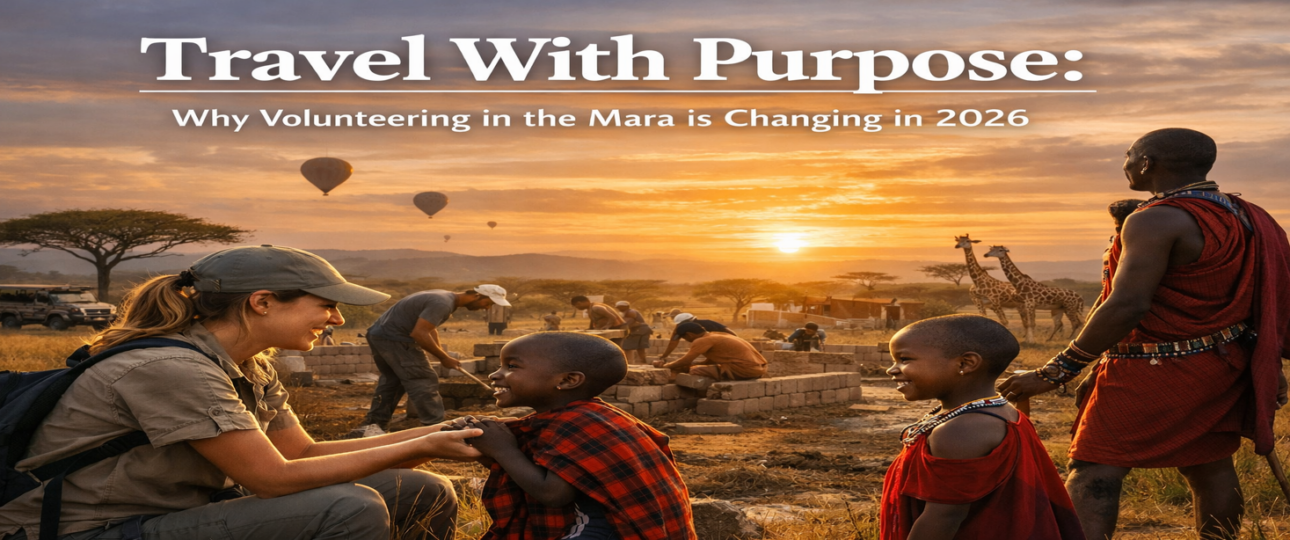
The age of the toothbrush‑painting, orphanage‑selfie safari is dying a slow, necessary death in the Mara. In 2026, the question isn’t “Where can I help?” but “Am I ready to be held accountable for the help I say I’m giving?”
The Maasai Mara has grown teeth, receipts, and a long memory.
The Mara Is Done With Feel‑Good, It Wants Follow‑Through
You’re not flying into an untouched wilderness that needs rescuing; you’re arriving in a highly organised, fiercely negotiated landscape.
Over the last decade, land under conservation in the Mara conservancies has risen from roughly 110,000 hectares to about 178,000 hectares, and the number of conservancies has leapt from 8 to 24. That’s legal agreements, board meetings, and elders arguing over maps under acacia trees.
Wet‑season wildlife surveys around 2022 found that about 83.4% of the wildlife in the greater Maasai Mara now spends its time in these community conservancies, not just the famous reserve. The wildebeest, zebras, eland, hartebeest, and little Thomson’s gazelles – they’re increasingly crossing land owned and leased by Maasai families.
Your “once‑in‑a‑lifetime sighting” is, quite literally, happening in someone’s long‑term investment strategy.
Buffalo populations, for example, climbed from roughly 7,500 in 2014 to over 11,600 by 2021, with elephants and giraffes also on the upswing. Fences that once strangled ancient migratory routes have been ripped out – about 2,025 hectares’ worth so far – and at least 11 wildlife corridors have been mapped and slowly reopened.
Meanwhile, luxury brands are pouring in money and marketing budgets. Travel and tourism outlets report 2026 as a boom year for “Conservation Safaris,” where guests join de‑snaring patrols, visit women’s cooperatives, and sit with community leaders instead of just sipping sundowners on a bonnet.
High‑end hotels now know they can’t just boast thread counts; they’re expected to demonstrate how their guests, staff, and, yes, volunteers plug into accredited community and conservation projects that deliver real outcomes.
On top of that, the Mara is being sold to the world under a unified “One Mara” brand, a Narok‑County‑backed push to coordinate conservancies, government, and tourism so this doesn’t turn into a free‑for‑all. The governor called it a strategy that “unifies the Maasai Mara experience” and raises marketing standards.
The Mara doesn’t want your heroic chaos. It wants your alignment.
Follow the Money, Meet the Reality
Let’s be impolite for a second and talk money, because the Mara certainly is.
Community conservancies now pay guaranteed lease income to more than 16,500 landowners, adding up to about 1.125 billion Kenyan shillings every year – roughly 7.5 million dollars. That’s school fees, medication, and solar panels, not just a line on an NGO proposal.
One landowner said, “The revenue from leasing my land has enhanced my life; I can now take care of my family and take my children to school.” No hashtags. Just stability.
Conservancies and partner camps employ at least 571 conservancy staff and over 2,000 local people in safari camps, most of them young Maasai from nearby communities. The ranger smiling at you on patrol? Salaried. The waiter explaining your wine list in perfect English and Maa? Salaried. The mechanic getting your game‑drive vehicle unstuck after you insisted on “just one more” photo? Also salaried.
There’s livestock on the spreadsheet, too. Around 80,000 animals – about 30,000 cattle and 50,000 sheep and goats – have been vaccinated through conservancy‑supported programs, with improved bulls introduced to strengthen local breeds.
Even the roads you’ll use have their own impact line. About 60 km of roads have been graded and maintained to connect key conservancies like Enonkishu, Olchoro‑Oirowua, Lemek, Mara North, and Olare Motorogi, making it easier for both local residents and visitors to move across this shared landscape.
Goodbye “I’ll Help With Anything”, Hello Actual Job Description
Old‑school voluntourism loved vagueness: “You’ll help the community.” Doing what? “Helping.” Now, the Mara is politely – and firmly – asking for specifics.
Wildlife‑focused volunteers are increasingly based at structured hubs such as the Wildlife Tourism College of the Maasai Mara in the Pardamat Conservation Area. Pardamat covers around 26,000 acres owned by roughly 850 Maasai landowners, and it’s a mixed landscape where wildlife, livestock, and people are all supposed to coexist under zoned land‑use plans.
There, you’re not just tagging along; you’re supporting set wildlife-monitoring tasks, data collection, or conservation education under the guidance of trained professionals.
On the community side, programs like the Eco Farming and Water Project in Oloolaimutia revolve around tangible systems: maintaining a village water grid, experimenting with soils and new crops and herbs, teaching children about conservation and recycling, and building genuine intercultural exchanges with youth.
It’s less “take a selfie with some kids” and more “can you help us keep this pump working and then explain why recycling matters without sounding like a condescending documentary voice‑over?”
Volunteer organisations have responded by tightening their processes. Many now run year‑round with weekly start dates and stays of one to twelve weeks, which is great for your calendar and even better for continuity on the ground.
Before you even start, local teams typically walk you through cultural norms, safety, local rules, and brutally realistic expectations about what you’ll actually do.
And the skills asked are evolving. Program descriptions now openly encourage volunteers to bring “fresh energy and ideas” in areas like digital skills, business mentoring, or environmental education, not just physical labour.
One community initiative in the Mara (the Anyoraa Project), for instance, combines tutoring, digital literacy, eco‑farming, and water work in a single weekly schedule. You might spend your morning troubleshooting a laptop in a youth class and your afternoon checking for leaks along a village pipeline.
In 2024, a World Heritage Volunteers camp in the Mara, organised with UNESCO support, experimented with a different kind of service: cultural and ecological conservation linked directly to the World Heritage Convention. That meant volunteers were not just cleaning or building, but helping support heritage interpretation, awareness campaigns, and community‑led activities in a landscape recognised for both its wildlife and its culture.
Voluntourism, Meet the Law
The romantic fantasy of “I’ll just show up and help” doesn’t stand a chance against Kenyan law and county‑level planning anymore – and that’s precisely the point.
The Wildlife Conservation and Management Act of 2013 formally recognises community conservancies as a legal land‑use option. That single legal recognition gives communities the right to define how their land is used, how wildlife is managed, and how revenue is shared.
Under the Mara conservancy model, private landowners sign long‑term leases – up to 25 years – with tourism investors. Those investors guarantee lease payments, which means 18 of the 24 conservancies are already paying landowners consistently, while four more use bridge financing while they wait for investor partners.
Your presence as a volunteer now takes place inside a web of contracts, rights, and obligations that existed before you landed and will continue long after you go home.
Coordinating much of this is the Maasai Mara Wildlife Conservancies Association (MMWCA), created in 2013 to standardise governance, management plans, and benefit‑sharing across 24 conservancies covering about 178,668 hectares.
In its own impact language, the Mara conservancy model “stands as a testament to the transformative power of collaborative partnerships,” putting both community welfare and wildlife protection at the centre.
The “One Mara” Brand Marketing Strategy developed with Narok County is not just a brand refresh. It’s designed to improve collaboration, reduce bad publicity, promote responsible tourism, and reposition the Mara as a year‑round destination instead of a two‑month migration circus. The county’s governor describes it as a unified, elevated way to present the Mara to the world.
On top of that are big planning documents: the Greater Maasai Mara Ecosystem Management Plan (2023–2032), the Maasai Mara National Reserve Management Plan, and the Narok County Physical and Land Use Development Plan (2022–2032). These plans dictate where wildlife corridors must remain open, where settlements can expand, where roads should go, and which land uses are compatible in each zone.
Suddenly, the bar for a “good” volunteer project gets higher. Does it align with conservancy management plans? With county spatial plans? With One Mara? If not, it’s not “rugged” or “authentic.” It’s misaligned.
Women, Youth, and the Death of the “Savior” Narrative
If you’re still tempted by the fantasy of “going to help the poor,” the Mara has a gentle correction: the “poor” are now board members, rangers, entrepreneurs, and scholarship alumni with better data than you.
In 2014, women held exactly zero leadership roles in conservancies. Now, about 120 women hold leadership positions in conservancies, and roughly 52 of 462 rangers are female.
Beyond leadership, around 1,506 women have been trained in beadwork, and roughly 70 Village Savings and Loaning Associations have been formed with about 1,457 members. These groups build savings habits, entrepreneurship, and low‑interest lending networks—quiet revolutions happening around kitchen tables and under tin roofs.
For youth, a scholarship program has reached 2,257 students across 25 schools—1,689 girls and 587 boys—with a reported 98% transition rate. A local teacher describes MMWCA as “a beacon of hope for our girls,” saying they’re no longer just dreaming but actively contributing to the community.
The Wildlife Tourism College of the Maasai Mara gives young people vocational training in tourism and hospitality; many graduates now work in high‑end camps or run digital wildlife storytelling platforms that beam Mara stories straight to global audiences.
An internship program has placed around 50 graduates into conservancies and partner organisations, deepening the pipeline into conservation and tourism careers.
For volunteers, this means you’re walking into a room where the person explaining the project to you might be a young woman whose schooling was funded by conservancy lease payments, whose internship gave her experience, and whose current job pays her to manage people like you.
What “Travel With Purpose” Actually Looks Like on the Ground
So what does all this look like on a Tuesday morning in 2026?
- In the Pardamat Conservation Area, it might start with the sound of cattle bells and the low murmur of students packing field gear at the Wildlife Tourism College. You head out with a team of local rangers and trainees to record lion spoor, log wildlife sightings, or check areas where fencing once stood before 2,025 hectares of barriers were taken down to reopen corridors.
- In Oloolaimutia, “volunteering” might look like helping inspect sections of a community water grid – valves, pipes, flow – before shifting to a schoolyard where you and local staff run a session on recycling or climate resilience with a group of kids who absolutely will roast your accent for sport. The eco‑farming projects there dig into soil health, alternative crops, and herbs, tying food security directly to conservation education.
- At a community‑run camp like the Anyoraa Project, your day may be split between tutoring sessions, digital skills workshops, and very practical work on eco‑farming plots or water projects. You might go from explaining basic spreadsheet tricks to a youth group in the morning to walking out to check for leaks and infrastructure issues in the afternoon.
- And then there’s the heritage layer. When UNESCO worked with local partners to bring a World Heritage Volunteers camp to the Mara in 2024, participants engaged in hands‑on activities that linked ecological work with cultural conservation under the World Heritage Convention.
So, Should You Still Come?
If you’re craving a trip where you can swoop in, feel holy for ten days, and leave with a camera roll full of “look how much they needed me” photos, the 2026 Mara is going to be a very uncomfortable mirror.
But if you’re ready for a place where conservation comes with contracts, where lions share a landscape with spreadsheets, where young women in ranger boots call the shots, and where your role is to listen first, learn second, and act third – then yes. This is exactly where you should be.
Volunteering in the Maasai Mara in 2026 is no longer about you changing the Mara. It’s about letting the Mara, with all its laws, leases, livestock, leaders, and long memories, change you.