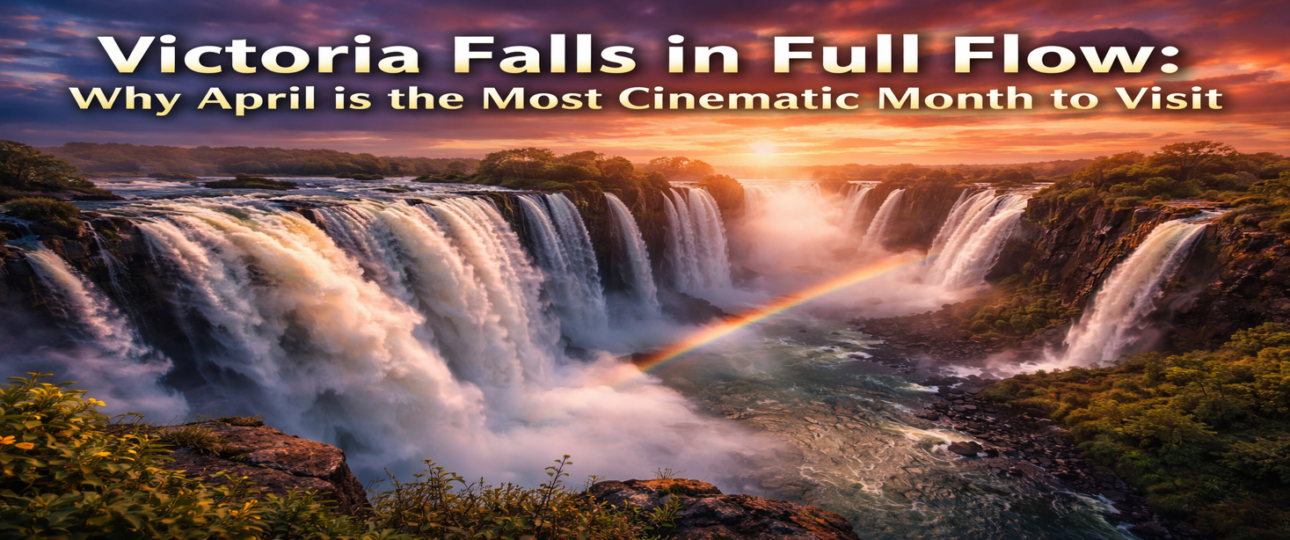
In April, Victoria Falls stops behaving like a waterfall and becomes a force of personality. According to VictoriaFalls-Guide, the Zambezi’s main catchment up in the Barotse floodplains sends a huge pulse of water downstream from February, with peak flow hitting the Falls between March and May—April is the crescendo, the moment the orchestra stands up and plays at full volume.
In April 2026, Victoria Falls is “at its fullest,” with the Zambezi swelling to over 500 million liters per second, a spray column visible from up to 50 km away, and thunder you can hear from several kilometers.
The Zambezi River Authority adds that long‑term mean annual flow at Victoria Falls sits around 1,100 m³/s, but the lowest annual mean ever recorded was just 390 m³/s in 1995/96.
When you show up in April, you’re stepping into the high‑water version of a place that has known true drought; the flood months feel like a rebuke to every climate‑doom headline that says “it’s over.”
The Falls in April: A 1.7‑Kilometer Wall of Chaos
You and I need to talk about that wall.
At high water, the entire 1.7 km‑wide curtain of Victoria Falls usually runs from end to end, a complete, unbroken sheet of water that simply doesn’t exist in the same way during low season, when some eastern cataracts on the Zambia side can partially dry out. In peak April conditions, all 1.7 kilometers are flowing at maximum capacity, with the spray rising more than 400 meters into the air.
During the flood season, which typically peaks in April, the spray can reach heights of over 400 meters and be visible from up to 50 km away.
This is where the Falls earn their original name, Mosi‑oa‑Tunya, “The Smoke That Thunders”—smoke that is really water, thunder that is really gravity having a bad day.
Why April Is the Most Cinematic Month (Even When You Can’t See a Thing)
The visuals improve exactly when your personal visibility worsens.
VisitVictoriaFalls.org describes April as “maximum flow” with less rain, still warm and humid, but with weather improving after the core rainy months—essentially, the sky clears just as the river loses its mind.
Wild Horizons, in a seasonal summary written for photographers, frames March–May as the “sweet spot” when the Falls are at their fullest, around April, when rains are tapering, and the bush is still lush—a vivid green frame around a white, raging curtain.
It’s not just pretty; it’s layered—green jungle, white explosion of water, black basalt gorge, and, because physics is generous, a constant halo of rainbows. Operators often mark April as one of the best months for broad daytime rainbows, even if your actual sightline to the falling water is partly swallowed by mist.
In February 2026, ZNBC quoted Assistant Site Manager Scholastica Muzandu, who explained that heavy upstream rains had pushed levels sharply higher, with peak conditions expected in March and April, and spray visible from far away—even while warning that mist can limit clear views at some vantage points.
So yes, April is cinematic in that “giant natural fog machine meets thunder soundtrack” kind of way. You won’t always see the falls clearly. You will absolutely feel them.
Ground vs Air: Two Very Different Movies
How you frame a shot is half the story. In April, Victoria Falls basically forces you to pick a genre.
On the ground, several high‑flow guides straight‑up warn that some viewpoints in April are “unusable.” You walk out to a viewpoint, the spray hits you like someone turned a showerhead to “revenge,” and your camera lens fogs over in seconds. Dramatic for video, hellish for delicate stills.
Machupicchu.org notes that in April, Zimbabwe’s viewpoints 6–12 can feel like standing in constant rain, with visibility so limited that you experience the Falls through sound, motion, and water on your skin more than through your eyes.
From the air (helicopter and microlight flights), though, it’s a different film. You can see everything the mist hides on the ground: the full 1.7 km curtain, the boiling cloud of spray, the gorge twisting away, and the green floodplain framing it all.
March–May, with the falls at full volume and the bush still lush, is prime time for aerial shots: you get the clean overhead perspective without spray constantly slapping your lens.
So April gives you a choice:
- Ground level is the intimate, chaotic, handheld indie film—all feeling, blurred scenes, soaked clothes, questionable hair choices.
- The helicopter is the wide‑angle cinematic epic, the establishing shot you put at the top of your reel so everyone knows you were there for the “full power” moment.
April vs Every Other Month: Why This Is the Drama Window
If you’re going to build an entire trip around one month, that month needs receipts.
- November–early February (low–rising water)
The river is rebuilding after low water; some sections still look modest. You get clear views of the rock formations and the gorge, great for landscape detail and certain adventure activities, but not that complete, a roiling wall of water. - March (very high)
Water is already “very high,” with hot, humid conditions and frequent rain.
Massive power, strong spray, and often more budget‑friendly shoulder prices—but ground visibility can be messy at best. - **April (maximum flow)
Multiple guides—including Wild Horizons, Namibia Tours & Safaris, and VictoriaFallsHQ—flag April as the typical peak‑flow month, when water levels are highest, and the falls are at their “absolute peak.”
You get the full curtain in flood, huge spray columns, intense rainbows, and lush, rain‑soaked surroundings, with operators openly calling this the moment for travellers who want “sensory overload” and cinematic intensity.adventureworld+2
- May–July (receding but still strong)
Water begins to recede, mornings turn dry and cool, and the air clears. This is where many guides—like VictoriaFallsHQ—nudge first‑timers: plenty of power, but better visibility and more comfortable weather. - August–October (low water)
Lowest flows; on the Zambia side, some eastern cataracts can dry up.visitvictoriafalls+1
Fantastic for cliff lines, exposed rock, Devil’s Pool, and big‑water rafting, but not ideal if you came for the mythic full‑curtain shot.
April is not the neat, sensible choice. April is the drama window.
Everyone Wants a Front‑Row Seat to Chaos
You’re not the only one drawn to this kind of spectacle.
The Zimbabwe side of Victoria Falls recorded 61,139 visitors in Q1 2025, with around 47,633 of those being international tourists—a year‑on‑year rise that shows demand not just recovering, but climbing.
By late 2024, a local analysis of VicFallsBitsNBlogs noted that visitor numbers through the rainforest had surged about 30% over the previous year, with roughly 1,300 visitors a day, up from 1,000 in 2023 for some months.
Even during the El Niño‑linked drought, it was “business as usual” at the Falls—boat cruises running, activities operating, guests still describing their experiences as spectacular.
So when you show up in April, you’re stepping into a destination that is not just surviving climate conversations, but actively growing, with people flying halfway across the world to be rained on by sideways water and call it “the best trip ever.”
The Science Behind the Poetry
The Zambezi River Authority states that the long‑term mean annual flow at Victoria Falls sits near 1,100 m³/s, with the worst‑recorded season, 1995/96, dropping to just 390 m³/s.
The high‑water months vary year to year depending on seasonal rainfall, but the pattern holds: the rainy season between November and April feeds a flood pulse that peaks in February and May, with April often as the climax. Sprays often rise more than 400 meters, sometimes double, visible from 50 km away.
So when local operators talk about a “perpetual rainstorm” in the rainforest and “deafening” sound during April, they’re not being poetic for brochure copy. They’re just describing what happens when hundreds of millions of liters of water per second drop off a basalt cliff.
April for Photographers and Filmmakers: The Beautiful Struggle
You and I both know the dark side of travel photography. You go halfway across the world, and your best shot is of your fogged‑up lens.
In April, some ground‑level viewpoints are so hammered by mist that you can’t see the waterfall clearly at all.
Wild Horizons, talking to photographers, calls March–May a “sweet spot” for aerial work: the falls are at their fullest around April, the bush is lush and green, and the light can be spectacular—but at ground level, you’re constantly battling spray.
So you pack waterproof covers, microfiber cloths, and perhaps a small willingness to let go of the perfect postcard shot and lean into the chaos.
April gives you the most cinematic experience, even as it sabotages your cinematic evidence. You’ll have shaky GoPro footage of white nothingness and your own cackling in the background—and that will actually be the most honest record of what the Falls felt like at full power.
What April Visitors Need to Know (So You Don’t Hate Me Later)
If we’re going to romanticise April, we should also warn you about the practical trade‑offs, so you don’t DM me later with “you didn’t say anything about being soaked for three hours.”
- You will get drenched.
High‑water guides recommend treating the rainforest walk as a wet activity: ponchos, waterproof covers for phones and cameras, and quick-drying lens cloths are not optional. - Some hero activities are off the table.
During high‑water season, including April, Devil’s Pool and Livingstone Island swimming are usually closed for safety, and certain white‑water rafting sections go on hiatus.
Instead, the spotlight shifts to helicopter flights, scenic walks, and gentler upstream river cruises that let you feel the power without becoming part of the flow.
- You’re trading crisp views for sensory overload.
April is for people who want “sensory overload and cinematic intensity,” while August–October is marketed more to travellers who prioritise activities like edge‑of‑the‑falls swims and big white‑water.
Adventure World Travel’s April note basically reads like a dare: peak flow, rainforest at its most vibrant, wet, atmospheric, dramatic—and yes, complicated for photography.
So, Should You Go in April?
If you want neat, controlled beauty, Victoria Falls in June or September will treat you kindly.
But if you want the waterfall equivalent of a live concert where the band plays too loud, the crowd sings every word, and the floor shakes under your feet, then April is your month.
Local executives quoted by VicFallsBitsNBlogs say that even in drought years, guests still walked away calling the experience “spectacular,” with cruises and activities running as normal.
Add that to Machupicchu.org April 2026 verdict—peak flow, over 500 million liters per second, spray visible from 50 km, a 1.7‑km curtain roaring at full capacity—and the answer writes itself. April is the most cinematic month to visit Victoria Falls because it doesn’t care about your comfort; it cares about making an entrance.
Go then if you can.
Let the “smoke that thunders” soak your clothes, fog your lens, wreck your hairstyle, and reset your sense of what a waterfall can be.