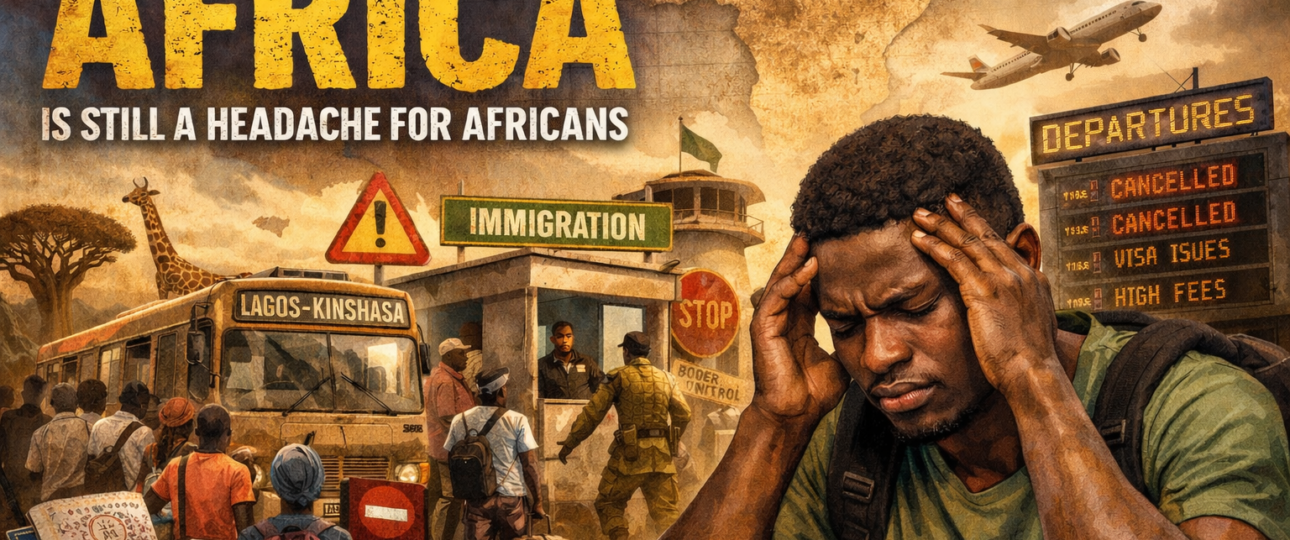
Imagine being the wealthiest person on the continent and still having to beg for permission to visit your neighbors. It sounds like a bad joke, doesn’t it? But for Aliko Dangote, who recently noted he needs 35 different visas to move across Africa, this is a frustrating daily reality. At The Walk Adventures, we believe that exploring our home soil should be as natural as breathing. The reality of African travel in 2026 is a tangled web of expensive flights, stubborn visa rules, and borders that often feel designed to keep us out rather than welcome us in.
We see the excitement in your eyes when you talk about visiting the white sands of Diani or the historical gates of Goree Island. However, we also see the heartbreak when a visa application is denied for no clear reason. Our mission at The Walk Adventures is to simplify these journeys, but we have to be honest about the hurdles we face. Data from the 2025 Africa Visa Openness Index (AVOI) show that our continental openness score has dipped to 0.445, the lowest level since 2021. This stagnation is a wake-up call for all of us who dream of a borderless Africa.
The Visa Paradox: Why Some Doors Are Closing
It’s a strange time for the African traveler: while some nations are throwing open the doors, others are bolting the locks. Rwanda and The Gambia remain the gold standards, sharing the top spot for visa openness in 2025. We love taking our groups to Kigali because we know the welcome starts the moment you land. These countries show that letting people in isn’t just a nice gesture; it’s a major boost to the local economy. Kenya has also stepped up, moving into third place after exempting citizens from 52 African countries from previous visa hurdles.
However, for every step forward, there seems to be a stumble backward. Four countries—Guinea-Bissau, Mauritania, Nigeria, and Somalia—recently ditched their visa-on-arrival policies. Now, travelers must navigate the often-confusing world of e-visas or traditional embassy visits before they can even book a flight. We find that these changes often happen overnight, leaving travelers stranded at boarding gates. This move back to “visa-required” status for 51.1% of the continent is the single biggest barrier to the “One Africa” dream.
Why is this happening when we are all talking about the African Continental Free Trade Area (AfCFTA)? Experts suggest that deep-seated inequalities make richer nations fear an “uncontrolled influx” of people. Even within our own borders, we see a “black-on-black” edge where immigration officers target fellow Africans more than foreign visitors. At The Walk Adventures, we believe this bias is our greatest internal obstacle. Until we trust each other’s documentation and security systems, the “Green Mamba” and other African passports will continue to struggle.
The High Cost of the African Skies
Have you ever noticed that it’s sometimes cheaper to fly to Dubai or Paris than to a neighboring African city? It’s one of the most frustrating things we deal with when planning your adventures. A one-way ticket from Nairobi to Lagos can cost over USD 900, while a longer flight to Dubai might only be USD 675. This isn’t just bad luck; it’s a systemic problem in our aviation sector. We often have to route our travelers through hubs in the Middle East or Europe just to get them to another part of the continent.
African airlines are currently facing a profitability crisis that directly affects their ticket prices. In 2025, carriers on the continent are expected to earn a measly USD 1.30 in net profit per passenger. Compare that to the global average, and you’ll see why our airlines have no “buffer” to lower prices. High fuel costs, which are 40% higher than the global average, and astronomical airport taxes are the main culprits. We at The Walk Adventures do our best to find deals, but when 60-70% of a ticket price goes to taxes and fees, our hands are often tied.
West Africa is currently the “capital” of expensive flying. Gabon is now the most expensive country to fly out of, with international departure charges reaching nearly USD 298. Compare this to Libya, where the fee is just USD 1.30, and you see the massive disparity in how we are governed. We find it heartbreaking that a South African might find it cheaper to holiday in Thailand than in Kenya because of these flight costs. The Single African Air Transport Market (SAATM) was supposed to fix this, but implementation has been painfully slow.
The Fuel and Operation Burden
Jet fuel isn’t just expensive here; it’s a logistical nightmare. Because of limited refining capacity and supply chain issues, our airlines pay a massive premium. At The Walk Adventures, we’ve seen how these fuel surcharges can double a fare overnight. Airlines also have to pay for aircraft leasing and maintenance in US Dollars, while their revenue comes in local currencies. This currency risk is a hidden tax that every African traveler eventually pays.
We often talk about the “Big Five” in wildlife, but there’s a “Big Five” in aviation challenges, too. Limited competition, high taxes, expensive fuel, currency risks, and poor connectivity keep our prices in the stratosphere. Foreign carriers like Emirates and Turkish Airlines use “hub-and-spoke” systems to fill large planes and reduce costs. Our local airlines simply can’t compete with that scale, leaving us dependent on outside hubs to visit our own people.
The Road Less Traveled: Border Nightmares and Safety
For many of us, the road is the only way to see the continent without breaking the bank. But if you’ve ever crossed a land border in Africa, you know it’s not for the faint of heart. Africa has the highest road traffic fatality rate globally, accounting for 24% of deaths with only 3% of the world’s cars. This makes safety a top priority for us at The Walk Adventures. We only use verified border crossings such as Namanga or Busia to ensure our travelers are safe and processed quickly.
Crossing a border by road often means dealing with more than just paperwork. In West Africa, logistical challenges at key borders can double the time and cost of moving goods and people. The Mfum-Ekok border between Nigeria and Cameroon is a prime example of where “inefficient services” cost millions. Travelers often report frequent roadside checks and “illegal payments” demanded by security forces. We find that digitalizing these borders is the only way to protect travelers from this petty corruption.
The infrastructure itself is often a barrier. While some “expressways” are being built at a cost of up to USD 9.2 million per kilometer, many regional roads remain unpaved or prone to flooding. We believe that “Infrastructure Africa 2026” must focus on these cross-border projects to truly unlock our potential. Until the roads are safe and the officials are honest, the road trip will remain a difficult dream for many.
Human Stories: The Real Cost of Restrictions
Behind every statistic is a human being who just wanted to go home or see something new. For instance, to get to Tunisia from Kenya, you may have to fly through Saudi Arabia and Italy because there are no direct routes.
Even business leaders like Aliko Dangote feel the sting of these borders. He recently complained that while a British passport holder can easily enter African countries, he has to “debate” his visa. This “colonial hangover,” where we trust outsiders more than our own, is a bitter pill to swallow. At The Walk Adventures, we hear these stories from our community every day. We believe that travel is a human right, not a privilege reserved for the elite or the “foreign.“
The cultural impact of these barriers is even more tragic. Travelers in 2026 are no longer satisfied with “surface-level” experiences; they want a deep connection. But how can we connect with Zulu homestays or Maasai storytelling if we can’t get past the airport in Lagos or Nairobi? When borders are closed, we lose the chance to see ourselves in each other. Our identity as Africans is tied to our ability to share meals, music, and stories across these imaginary lines.
The “Green Mamba” and the Power of the Passport
If you hold a South African passport, you’ve likely felt the pride—and the pain—of the “Green Mamba.“ In 2026, South Africa ranks 48th globally, offering access to 101 visa-free destinations. While that sounds good, it’s actually a drop from 106 destinations a year ago. We’ve seen access to countries like Nigeria and Mauritania decline, making spontaneous trips to West Africa much harder. At The Walk Adventures, we stay on top of these shifts so you don’t have to.
The disparity between African passports is staggering. Seychelles leads the continent, ranking 25th globally with 156 visa-free destinations. Meanwhile, many of our neighbors, especially those in conflict zones, hold some of the world’s most restricted documents. This “passport inequality” means that your ability to see the world and your own continent is often determined by where you were born. We believe that the AU Passport is the only long-term solution to this injustice.
Ghana’s recent decision to allow visa-free entry to all Africans is a game-changer. By early 2025, Ghana joined the elite group of “Open Doors” nations, fulfilling a promise made by President Akufo-Addo. This move is expected to boost tourism and trade, positioning Ghana as a leader in Pan-African unity. We are already seeing a 150% surge in arrivals in countries that have dropped visa requirements.
Regional Blocs: The Saving Grace?
When the continent-wide plans move too slowly, our regional blocs often pick up the slack. The East African Community (EAC) has been a pioneer with the East Africa Tourist Visa (EATV). For USD 100, this visa allows you to move freely between Kenya, Uganda, and Rwanda for 90 days. It’s a “one-stop-shop” that we highly recommend for anyone doing a multi-country safari. However, you have to be careful: the moment you leave the “tri-country zone” (like flying to South Africa), the visa becomes invalid.
The Southern African Development Community (SADC) is also moving toward its own “Univisa.” Five countries—Angola, Mozambique, Namibia, South Africa, and Zimbabwe—are currently piloting this initiative. We think this is a huge win for tourism in the Kavango Zambezi (KAZA) area. SADC also boasts high levels of reciprocity, with many neighbors recognizing national IDs for border crossings.
But even these successes have their “traps.” For instance, the EATV does not cover Tanzania, Burundi, or the DRC. We’ve seen many travelers arrive in Arusha thinking their East Africa visa covers them, only to be hit with a separate fee of USD 50-100. At The Walk Adventures, we make it our business to know these nuances so you don’t have a “logistical nightmare” on your vacation. Regional integration is a great start, but it can create “islands of openness” in a sea of bureaucracy.
The Economic Cost of Staying Put
Did you know that intra-continental trade accounts for less than 13% of Africa’s total trade? Compare that to 66.9% in Europe, and you see why our economies are so vulnerable to global shocks. When we can’t move people, we can’t move goods, and we can’t move ideas. The Mo Ibrahim Foundation points out that our dependence on external markets leaves us vulnerable to crises such as the Russia-Ukraine war. At The Walk Adventures, we see tourism as a form of “trade” that needs to be liberalized.
The African Union’s Agenda 2063 has a bold goal: to double tourism’s contribution to our GDP by 2033. But to get there, we have to dismantle the structural barriers that keep us apart. We need to focus on people, ensuring that local artisans, guides, and storytellers benefit from our travel. Growth without sustainability is short-lived, and we believe that community-led tourism is the only way forward. Our future depends on our ability to listen to each other’s stories, not just look at each other’s scenery.
We are also seeing a rise in “Black Identity Travel,” where members of the diaspora return to find their roots. Events like the “Year of Return” in Ghana have demonstrated the significant potential of reparative tourism. But even this is threatened by high flight costs and complex visa rules. At The Walk Adventures, we want to be a bridge for everyone, whether you’re on the continent or in the diaspora, helping you find your way home. We believe that every border we open is a step toward healing our shared history.
The Walk Adventures: Your Partner in the Journey
We know all of this sounds a bit daunting, but that’s why we’re here. At The Walk Adventures, we’ve made it our mission to handle the “messy” parts of travel so you can focus on the “magic.” Our guides are experts at navigating the “black-on-black” edge and ensuring you are treated with the respect you deserve. We use our “insider knowledge” to avoid the chokepoints and find the direct routes that don’t appear on standard search engines.
Whether it’s a “Bush-to-Bush” private charter flight in East Africa or a luxury safari through the SADC region, we tailor every trip to your specific passport and needs. We believe that travel should be a transformation, not just a trip. By focusing on authenticity and community engagement, we ensure that your adventure leaves a positive mark on the people you meet. Us, you, and the continent—we are all in this together, and we won’t stop until every corner of Africa is as accessible as your own backyard.
The Road to 2030: Is the Dream Dead?
With the 2026 safari season upon us, many are asking if the dream of “One Africa” is dead. We don’t think so. Despite the stagnation in the AVOI scores, 39 countries have improved their openness since 2016. We are seeing more e-visa portals (now 31 countries) and a growing realization that “outdated models of movement restriction are counterproductive.” The “Trans Africa Tourism and Unity Campaign” and other grassroots movements are keeping the pressure on our leaders to do better.
We are moving in the right direction, even if the pace is slower than we’d like. The African Union is finally acknowledging the gaps in our identification systems and working to harmonize our documentation. We believe that by 2030, the “islands of openness” will finally start to merge into a single, connected continent. Until then, stay curious, stay adventurous, and let us handle the paperwork. Your African odyssey is waiting, and we are ready to take that first step with you.
Key Takeaway
Traveling around Africa remains difficult for Africans due to a combination of restrictive visa policies (51.1% require visas before travel), high airfare (taxes average USD 68), and significant road safety risks. However, regional initiatives like the East Africa Tourist Visa and bold moves by countries like Kenya, Ghana, and Rwanda are slowly breaking down these invisible walls. The Walk Adventures is committed to helping travelers navigate these challenges to foster a truly integrated and connected continent.