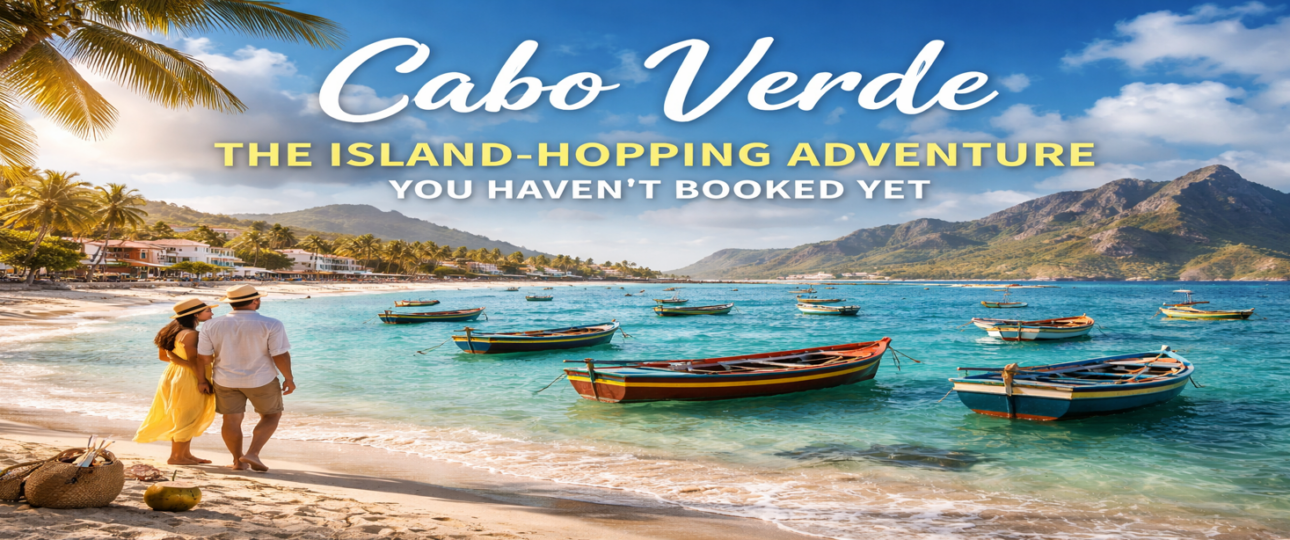
Cabo Verde is not the kind of place you “do” in a week and then forget between laundry cycles. It’s the archipelago that keeps showing up at the edges of travel stats — 1.2 million visitors in 2025, hotel beds 72% full — while quietly hiding an entire second act behind the resort gates.
This is where you trade one‑island boredom for nine‑island drama: volcanoes that still remember how to erupt, valleys carved into green catwalks for hikers, turtles nesting under a sky that doesn’t know light pollution, and nights in Mindelo and Praia that end with you dancing to morna and funaná like you’ve known them your whole life.
And you? You’re still booking the same one‑island, one‑pool, one‑regret holiday. Let’s fix that.
Cabo Verde Is Done Being Humble
Cabo Verde has receipts. In 2025, it welcomed 1.248 million guests, up 6% from 2024, with 6.12 million overnight stays (8.3% growth), and a Q4 that alone hosted over 400,000 visitors and 1.7 million nights. The average stay is now 4.8 nights, nudging hotel occupancy from 60% to a very smug 72%. That’s not “hidden gem” energy; that’s headliner at the festival.
Tourism is a double‑digit slice of GDP, with the UK, Portugal, Germany, France, Belgium, and the Netherlands popping over on short flights like they’re running to the corner shop. The archipelago has already arrived — it’s just politely waiting for you to realize the beach is the least interesting thing about it.
An Archipelago Where 19 Out Of 20 People Refuse To Archipelago
Here’s the chaos: around 80% of tourists stay on Sal or Boa Vista, parked in resorts like they’re allergic to curiosity. A World Bank–backed study says fewer than 10,000 visitors a year actually do proper multi‑island hopping — roughly 5% of all arrivals. That means 1 in 20 is out there climbing ridges and riding ferries, while the rest are queuing for the omelet station.
Cabo Verde’s 2022–2026 tourism plan looked at this and said, “Absolutely not.” It officially targets 1.2 million visitors while promising to deconcentrate tourism by improving domestic flights and promoting quieter islands to spread people — and money — around.
Operators and adventure brands see the gap and are pouncing: island‑hopping is the next big niche, and right now it’s still delightfully underbooked.
The Flights Are Shorter Than Your Excuses
Logistics? Deliciously dramatic and surprisingly easy. Most inter‑island hops are 30–60 minutes on TACV Cabo Verde Airlines — barely enough time to overthink anything. Sal’s Amílcar Cabral and Santiago’s Nelson Mandela airports play diva‑level gatekeepers, pulling in more European connections, including low‑cost carriers like EasyJet.
Operators now offer 2–3‑week island circuits — Sal → São Vicente → Santo Antão → Fogo → Santiago → Boa Vista — like a curated playlist instead of a single overplayed track. You can touch down on Sal in the morning, be in Mindelo by midday, and sail to Santo Antão before sunset. The infrastructure is practically screaming, “take me seriously,” while mainstream brochures are still mumbling, “just pick a resort.”
Sal & Boa Vista: The Gorgeous Trap
Sal is the glossy album cover. You get Santa Maria’s honeyed beach, the Buracona “Blue Eye” lava pool, and the ghostly Pedra de Lume salt pans, relics of the island’s salt‑rich past. The trade winds show up like clockwork, making Sal a temple to kite‑surfing, windsurfing, and diving in sapphire water. It’s seductive. It’s fun. It’s also just the foyer.
Boa Vista is where the Sahara flirts with the sea. Praia de Chaves and Praia de Santa Mónica unfurl in huge, quiet sweeps, backed by the pale dunes of Deserto de Viana. Loggerhead turtles slide ashore between June and October, and whales throw themselves joyously out of the Atlantic from February to May.
These islands are stunning — but if you stop here, Cabo Verde will smile, pour you another drink, and keep its deepest secrets for someone braver.
São Vicente & Mindelo: Nightlife With Main‑Character Energy
Then there’s Mindelo, on São Vicente — the island that shows up late, steals the show, and leaves with your heart. This port city is Cabo Verde’s cultural capital, all cafés, harbor bars, and live music spilling onto the streets like the speakers gave up on boundaries. Festivals like Baía das Gatas and Kriol Jazz get the headlines, but any random Tuesday can feel like a tiny, loud miracle.
Mindelo is also your launchpad: ferries and short flights shoot out toward Santo Antão and Fogo, turning a night of music into the prelude to your hiking saga. Cabo Verde’s signature sounds — morna, funaná, coladeira — aren’t staged experiences; they’re oxygen. You don’t just go “out”; you get folded into the soundtrack.
Santo Antão: Where Trails Judge Your Life Choices
Santo Antão is the island that looks at your cardio and laughs. Think vertiginous, terraced valleys like Ribeira Grande and Paúl, carved into the green like an architect got obsessed with staircases. You walk along caminhos vicinais, century‑old village paths that now double as 10–15 km hiking days with 500–1,200 m elevation changes. Bring good shoes and a flexible ego.
This isn’t just wild beauty; it’s curated. With World Bank support, Cabo Verde has rehabilitated and signposted 47 km of trails and digitally mapped 309 km for platforms like Wikiloc and AllTrails. They’re also investing in viewpoints, trail upkeep, and community training, so the island can handle more hikers without losing its soul.
Santo Antão is not “off the beaten path” — it is the path, and it’s being sharpened for its close‑up.
Fogo: Drama Queen Of The Atlantic
On Fogo, the main attraction is an active volcano with resting‑villain energy. Pico do Fogo rises to 2,892 m, last erupted in 2014, and is now a standard entry on Cabo Verde’s unofficial “so you think you’re adventurous” checklist. Hikers climb ash‑grey slopes to the crater rim, where the views are spectacular, and your survival instincts suddenly seem very chatty.
You then descend into Chã das Caldeiras, a village inside the caldera where people farm, pour wine, and host guests on black volcanic soil. Short, intense itineraries pack crater hikes, lava‑tunnel explorations, and coastal walks into 2–3 nights. It’s a place where you wake up, stretch, and remember you voluntarily slept inside a volcano. Therapy later. Photos now.
Santiago: History, Surf, And Beautiful Complications
Santiago carries the heavy crown: history, politics, and identity, all in one island. Cidade Velha, a UNESCO World Heritage site, keeps its colonial fort and stone streets as a reminder of Cabo Verde’s role in Atlantic trade — including the brutal, unskippable reality of slavery. Not far away, Praia mixes surfable bays like Tarrafal with street art, rooftop bars, and the Plateau district’s music‑soaked nights.
In Serra Malagueta Natural Park, trails thread through rural communities and ridgelines, attracting travelers who want their hiking with a side of context. Santiago is the island that refuses to be just “pretty.” It wants to talk about where you come from, what you know, and why you travel at all.
Cabo Verde Is Literally Training For You
This glow‑up is not accidental. In AdventureWEEK 2026, the Adventure Travel Trade Association (ATTA) and Cabo Verde’s Tourism Institute flew in 14 international tour operators and media from 10 countries to test‑drive island trails. They walked crater rims on Fogo, coastal paths on São Vicente, and village routes on Santo Antão, treating the archipelago like the hiking diva it wants to become.
ATTA president Gustavo Timo answered his own question: Can Cabo Verde be a world‑class hiking destination? Yes. The ingredients are already there; the challenge now is scaling infrastructure and community‑linked offers.
The Tourism Institute has trained around 80 local guides and is working on better signage, more lodging, and improved domestic‑flight schedules to make multi‑island adventures seamless. This isn’t a casual fling with adventure tourism; it’s a full‑time commitment.
Morabeza, Local Tables, And Saying No To Buffet Prison
Cabo Verde has branded its secret weapon: morabeza, that relaxed, generous sense of welcome that has no direct translation but shows up in extra food, shared chairs, and “stay a bit longer” smiles. Tourism insights show more travelers breaking out of resort bubbles to eat in local tascas, join cooking classes, book homestays, and attend festivals like Kriol Jazz and Gamboa.
A World Bank report underscores that demand for “local‑experience tourism” — family‑home meals, craft visits, small‑group cultural tours — is growing fastest on islands like Santiago, Santo Antão, and Fogo. This is the opposite of “all‑inclusive anonymity.” It’s messy, human, musical, and impossible to replicate on a cruise ship.
Climate Reality Check: Go Now, But Go Better
Now for the dark eyeliner: climate change. The World Bank estimates that Cabo Verde’s GDP could fall by up to 3.6% by 2050, with tourism heavily exposed as sea levels rise and beaches erode. The response has been unapologetically strategic: push renewable energy and eco‑lodges, and shift away from pure sun‑and‑beach into hiking, ecotourism, and culture‑based trips that spread visitors and risk.
The 2022–2026 tourism plan names adventure and nature tourism as the keys to inclusive growth, channeling more income into communities beyond the resort strip and easing pressure on Sal and Boa Vista. Every time you book a local guide, stay in a village guesthouse, or choose a multi‑island itinerary, you’re not just being interesting; you’re voting for a version of Cabo Verde that stands a better chance in a hotter world.
When To Go, How To Outsmart The Crowds Like The Diva You Are
If your ideal forecast is “sunny, not sweaty, and perfect for smug hiking selfies,” November to June is your window, with 21–25°C and relatively low humidity. Sal and Boa Vista are busiest in December–March, when half of Europe descends in search of a winter tan. Slide into April–June, and you still get the good weather with fewer humans elbowing you at breakfast.
The only real diva in this story is the domestic flight schedule. Seats between islands can be limited, which is why many smart travelers let operators bundle multi‑island flights into package deals. You’ll also need to pre‑register online and pay an Airport Security Fee (TSA) before you arrive — mildly annoying, yes, but a small ritual before stepping into an archipelago that’s about to rearrange your definition of “beach holiday.”
Right now, Cabo Verde is standing in the wings, fully costumed, mic on, watching the audience file into the wrong theater. The islands have the music, the trails, the data, the plans; they’re already playing to over a million visitors a year, and still most people never leave the first act.
You can be that person — same resort, same buffet, same stories — or you can start booking flights that hop, ferries that cross, hikes that burn, and nights that end with morna in your chest and volcanic dust on your shoes.
Which island is calling you louder — the mind‑bending trails of Santo Antão, the volcanic drama of Fogo, or the neon‑lit nights of Mindelo?