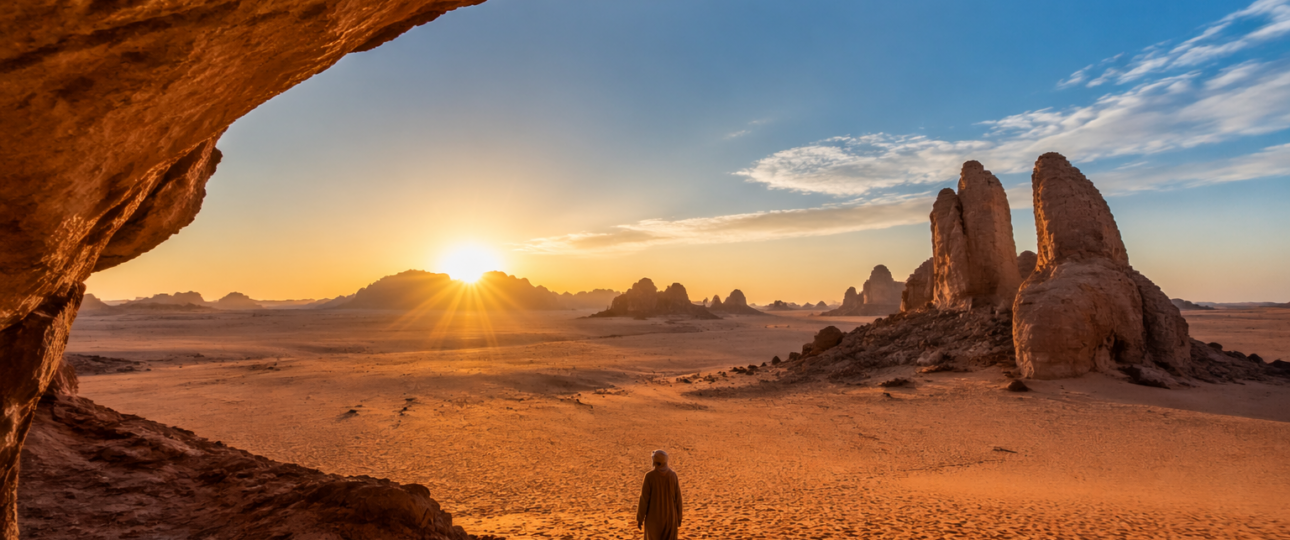
You’re used to Africa being sold as the same looping reel: lions at golden hour, a lone acacia doing its best “National Geographic” pose, a safari jeep stalking the same five animals everyone flew in to collect like trophies. Nice, sure. But also… copy‑paste.
Up on the map where the color turns to beige, Algeria’s Sahara has been sitting there for years, written off as a blank stretch you cruise past on your way to the “real” stars — the Serengeti, the Okavango, the big‑five bingo card. 2026 has other plans.
The Algerian Sahara is done playing backdrop; it’s crashing the spotlight, shaking the sand out of its hair and saying, “Tell the lions to wait — I’ve got a whole different show lined up.”
So, why Algeria’s Sahara, and why now?
You’re not late. You’re early.
Big‑name travel editors are only just waking up to Algeria. BBC Travel has slotted the country into its “must‑visit in 2026” lists, and they’re not talking about beaches or big cities — they’re talking Sahara, heritage, and the fact that it still feels like the real thing, not a stage set. CNN points out that Algeria only really swung its doors open in 2023, with simple 30‑day visas and fresh direct flights from European hubs and Montreal. For decades, this place kept to itself. Now it’s cautiously saying, “Okay, come in. But wipe your feet.”
On the ground, small operators are putting together “Algerian Sahara treasures” trips for late 2026 — Tuareg‑led camping, long drives across empty horizons, evenings that stretch out over mint tea instead of hotel buffets. You’re stepping into a destination that’s just starting to believe in its own tourism story. It still has the awkward charm of someone who doesn’t quite realize they’re gorgeous.
A tourism boom that still feels like a conversation, not a crowd
The tourism minister literally calls Saharan tourism a “locomotive for local development,” and she’s very clear: the desert isn’t just a product to sell, it’s a “sustainable ecosystem” tied to community life and national identity. That’s not just nice wording. In the 2024–2025 season, the southern Sahara welcomed about 500,000 visitors, including 48,000 foreign tourists. The country as a whole pulled in around 3.55 million visitors in 2024 — more than 2.45 million of them foreign — which is “buzzing,” not “overrun.”
Down south, bed capacity is still catching up. Tourist numbers are rising, but many towns are just now adding hotels and auberges, with new properties expected in 2026. So you get this in‑between world: your guesthouse might not have a spa menu, but it will absolutely have a host who pulls up a plastic chair, sits down next to you, and starts talking about what tourism might mean for their kids.
Traveling through a desert that’s being rewired in real time
Here’s what makes this desert feel different from a typical “end of the road” trip: the road is literally being rebuilt while you’re on it.
Algeria is stitching the Sahara into its economic heart. Take the Laghouat–Ghardaïa–El Meniaa railway: about 495 km long, with a price tag of roughly USD 2.8 billion. It’s not just a line on a map; it’s the first piece of a planned backbone that will eventually run south toward Tamanrasset and then on to Niger. A space that used to be a blank patch between “north” and “Sahel” is becoming a corridor — for goods, for people, for ideas.
Then there’s the Trans‑Sahara Gas Pipeline, finally moving from talk to “imminent” construction in 2026. It will link Algerian gas through Niger to Nigeria and onward to Europe, sliding right through the heart of the Sahara. Analysts point out that Algeria’s renewed diplomatic tango with Niger and other Sahel states isn’t random; it’s about securing these routes and standing its ground against rival Atlantic projects. The African Development Bank even praises Algeria’s “technical strength and long‑term vision” in these desert megaprojects.
Traveling here, you don’t just see sand and sky. You feel the hum of an entire country using that sand and sky as leverage.
The sun isn’t just warm, it’s on the payroll
Let’s talk about the sun — because in the Algerian Sahara, it’s not just giving you a tan, it’s paying the bills.
2026 is a big solar year. Nine new solar plants are scheduled to come online, adding around 1,480 MW of electricity to the grid. Two of them are expected to start feeding power in the first part of the year. One of the stars of the show is the M’Sila project, a 1,000-MW solar plant worth about 1.2 billion USD, expected to generate some 2 TWh of clean power annually once it’s up and running in mid‑2026.
On top of that, Sonelgaz and partners such as TotalEnergies and Enel are rolling out 500‑plus MW of additional capacity in Saharan regions like Laghouat and Ghardaïa. All this energy plugs into a bigger idea: the SoutH2 corridor, a planned 3,300 km green hydrogen highway that could move up to 4 million tonnes of hydrogen from the Sahara to Italy, Austria, and Germany by 2040 — roughly 10% of Europe’s expected demand.
Algeria’s own targets are equally bold: 15,000 MW of renewables by 2035 and 27% of its electricity from renewables by 2030. So when you see solar fields gleaming in the heat haze, you’re not just passing infrastructure; you’re looking at one of the main reasons the world is suddenly very interested in this “empty” desert.
Bread, dates, and the gamble of growing food in the sand
Of course, you can’t eat kilowatts. So Algeria is doing something bolder than a few token oases: it is trying to grow dinner in the desert.
The government is pushing to expand cultivated land in southern regions to 500,000 hectares to hit wheat self‑sufficiency around 2025, and then do the same for barley and corn by 2026. Over the longer term, the plan is to reach more than one million hectares of desert farmland by 2028, mostly cereals and legumes. From the air, those center‑pivot circles of green look like someone dropped crop circles across the sand.
Then there are the date palms — the quiet veterans of this game. Between 1984 and 2021, Saharan date‑palm plantations in Algeria roughly doubled to about 71,000 hectares, supporting some 2.2 million people. In 2022, Algeria ranked as the world’s third‑largest date producer, with about 1.25 million tonnes harvested from around 18 million palms, many of which were clustered in provinces like Biskra.
Some writers looking at this “greening the Sahara” experiment say Algeria has what it needs to become a “great nurturing nation again”: sunlight, limited but usable water, huge land, and plenty of hands — especially if it leans into regenerative techniques like windbreak hedges, micro‑basins, and agroforestry. Others warn that mega‑farms in North African deserts can be a “mirage of food security” if they burn through groundwater and bypass small farmers.
As a traveler, you land in the middle of that debate every time you break a crust of bread or bite into a date that tastes like caramelized sunlight.
Rock art, Tuareg guides, and 8,000 years in your peripheral vision
If you’re the kind of traveler who likes your landscapes with a side of time travel, Algeria’s Sahara delivers in ridiculous quantities.
In Tassili n’Ajjer National Park — about 80,000 km² of sandstone and silence — more than 15,000 rock paintings and engravings track life along the Sahara’s shifting edge from roughly 8,000 to 1,500 years ago. Cattle, hunters, masked figures, boats: a reminder that this wasn’t always a desert the way you see it now. Today, Tassili is both a UNESCO World Heritage Site and a Biosphere Reserve, sitting at the crossroads of Libya, Niger, Mali, and Algeria.
Most trips out here funnel through Djanet. From there, Tuareg guides lead you into “stone forests” — narrow canyons, towering rock walls, hidden plateaus — and you camp under skies that make your city constellation app feel deeply inadequate.
What makes this especially cool is how it links to the rest of the country. Many itineraries pair the desert with Constantine’s cliff‑hanger bridges and Roman ruins like Timgad and Djémila, so you end up walking through layers of Phoenician, Roman, Arab, Ottoman, and modern history in one trip. It’s less “see the animals before lunch” and more “let’s see how many civilizations we can cross before your next coffee.”
Snow on the dunes and a climate story you can actually feel
And then, just when you think you’ve got the Sahara figured out — hot, dry, predictable — it throws a curveball.
On a morning in January 2026, dunes near Ain Sefra, often called the “Gateway to the Desert,” woke up wearing a thin, bright white coat. Snow in the Sahara. Again. For a few hours, sand that usually bakes under some of the highest temperatures on Earth was dusted in ice crystals, thanks to a clash between cold European air and moist Mediterranean winds. It’s not even the first time: there were similar episodes in 1979, 2018, 2021, and 2023, each one lighting up social feeds and climate debates.
Meanwhile, research suggests Algeria’s rainfall could drop by 5–13%, and temperatures rise by 0.6–1.1 °C by 2030, intensifying desertification. The desert isn’t just a place; it’s a barometer.
Algeria’s answer includes a National Climate Plan that aims to cut emissions by 7% by 2030 on its own, and up to 22% with international support, focusing heavily on energy, agriculture, water, and transport. There’s also the “Great Green Dam,” a planned 2.4‑million‑hectare forest belt intended to slow the desert’s advance and support pastoral communities along its edge.
Standing on a dune here, you feel all of that at once: the beauty, the fragility, the weirdness of snow on sand, and the quiet urgency behind all those solar panels and tree belts.
Put all of this together, and the Algerian Sahara stops being a beige blur at the top of the continent and turns into a full‑blown character: opinionated, restless, very much in the middle of things.
If you’re bored of trips that feel like you’ve walked into someone else’s template — same lodges, same jeeps, same five animals on repeat — this is your pivot. Algeria is a place where you can watch a country renegotiate its future in real time, then walk outside, tip your head back, and see 8,000 years of stars looking down like, “Finally, you showed up.”