You and I are going to the river together.
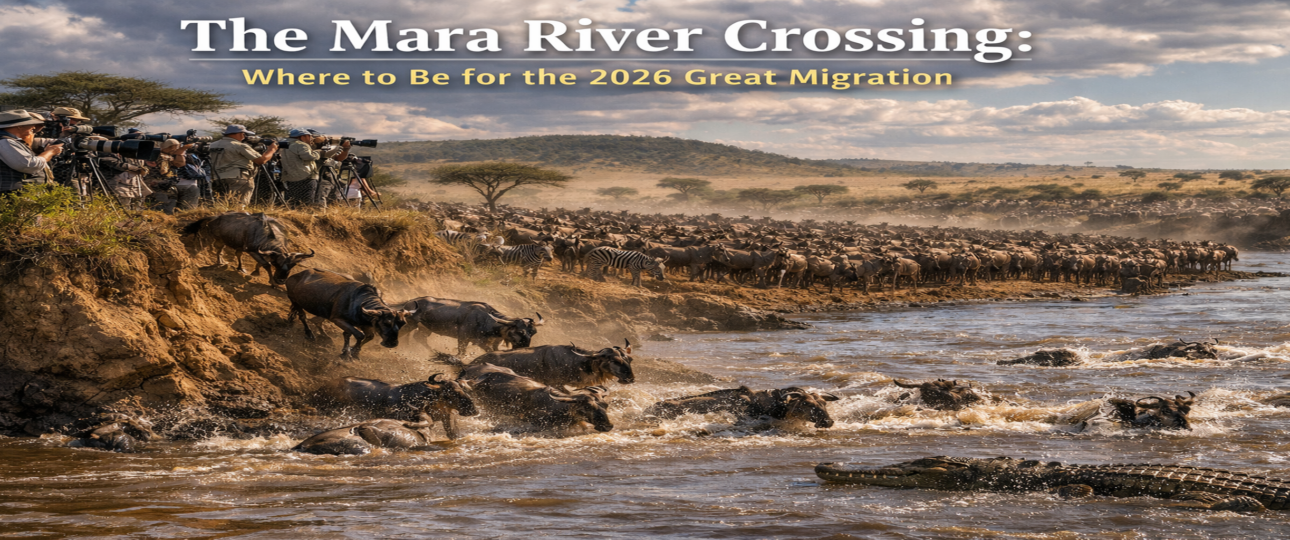
Not in body, maybe, but in spirit: dust in our teeth, adrenaline in our veins, watching a brown, churning scar of water decide—on its own sweet, brutal terms—who lives, who drowns, and who walks away dripping and triumphant.
And 2026? This isn’t the old “just rock up in August and hope” era anymore. The Great Migration is still mythic, still goosebump‑worthy, but it’s also more climate‑shaken, more crowded, and much less forgiving for anyone planning with vibes instead of data.
The One Week You Should Bet Your Money On
Okay, but when should you actually go?
Kenyan migration specialists at MasaiMara.ke, who track long‑term movement data alongside recent rainfall trends, currently place the highest‑probability window for peak Mara River crossings between about 22 August and 7 September 2026. That’s not a guess; it’s their forecast after watching several recent seasons misbehave.
They point out that in 2022, 2023, and 2025, the first sustained crossings shifted slightly later, often starting in early August instead of mid‑July, then continuing into late September or even early October when the rains showed up late. In other words, the migration’s body clock is running a little behind the old schedule.
The rhythm is like this: small, twitchy crossings in the northern Serengeti in late July, big headline crossings through August, constant back‑and‑forth crossings across the Mara River through September, and then a slow taper in early October as the short rains pull the herds south again.
If you can only pick one week for the 2026 crossing, make it the last week of August or the first week of September.
The Numbers Are Insane (and a Little Horrifying)
To understand why people obsess over this event, you have to feel the scale.
Safari and conservation sources estimate the Great Migration at around 1.5 million wildebeest, close to a million zebra, and thousands of gazelles and other antelopes moving between the Serengeti in Tanzania and the Masai Mara in Kenya. It’s the largest overland mammal migration on the planet—planet, not just Africa.
But the river is where the beautiful marketing language ends. Conservation and safari experts estimate that around 250,000 wildebeest die every year during the migration, and most of those deaths happen at river crossings, where steep muddy banks, strong currents, crocodiles, and pure exhaustion turn courage into casualty.
One Kenya‑focused safari resource notes that by late August 2024, roughly 65% of the main herds were already inside the Masai Mara, which tells you how much of that living ocean is often packed into the Mara system by late August in a “normal” year.
So yes, the Mara River is a photographer’s dream. But it’s also the deadliest bottleneck in the ecosystem—and you’re buying a front‑row seat to watch the coin toss.
Kenya’s Secret: The River Has Micro‑Seasons
Most people talk about “the Mara River crossing” like it’s one big, singular event. It’s not.
On the Kenyan side, the river behaves like a chain of micro‑seasons, each strung along a different bend, each with its own timing and energy.
Migration mapping from MasaiMara.ke identifies several key crossing points: Lookout Hill, Cul de Sac, Paradise Plains, Serena’s Crossing, and Mortuary. They’re all in the same river, but each one has its moment.
Down in the southern Masai Mara, near the Sand River, you have Lookout Hill Crossing, one of the first major Kenyan entry points for herds coming up from Tanzania. When things run on time, this stretch wakes up around 1–10 August. It’s where the first large waves of wildebeest step out of the Serengeti and officially “clock in” to Kenya.
Move downstream, and you reach Cul de Sac in the central Mara plains. This is a tighter, more claustrophobic bend of the river where the channel squeezes the herds into narrow launch points. It tends to fire in mid to late August, right in the build‑up to peak season. Think of it as the point where the traffic jam becomes a torrent—columns of animals stack up on the bank until one nervous pioneer jumps and the rest follow in a deafening blur.
North of that lies Paradise Plains Crossing, just above Cul de Sac, in the aptly named Paradise area. This section is particularly active in late August, overlapping that 22 August–7 September 2026 peak‑probability window. It’s a favorite for those big, cinematic wide‑angle shots: vast herds flooding through the frame, the river cutting a dark line through golden grass.
Keep following the river into the Mara Triangle, and you hit Serena’s Crossing, near the Mara Serena Safari Lodge. Recent years have seen strong activity here between about 15 August and 5 September, making it a star player for travellers staying in the Triangle’s more regulated, lower‑density sector.
Deeper into the Triangle, things get moodier at Mortuary Crossing. The name alone tells you this isn’t a gentle place. Mortuary tends to come into its own in September, when herds that have spread through the northern ecosystem start shifting histrionically back and forth, crossing north and then south again across the river.
- Early August is the domain of Lookout Hill and Sand River in the south—your first‑wave Kenyan action if the herds are on schedule.
- Late August is when Cul de Sac, Paradise Plains, and Serena’s Crossing roar to life in central and northern Mara, lining up perfectly with the 22 August–7 September peak window.
- September belongs to the Mara Triangle and Mortuary, with intense, sometimes smaller but often less crowded crossings as the herds criss‑cross the river following localized showers.
Same river, different verses. Knowing which verse you want to stand beside is half your 2026 strategy.
Tanzania’s Ace Card: Longer Windows, Quieter Banks
Yes, your heart is probably Mara‑centric.
But if we’re being honest—whisper‑level honest—the northern Serengeti is the unsung hero of Mara River viewing.
EnjoRe Safaris, which specializes in Great Migration safaris, calls the northern Serengeti around Kogatende the best place in Tanzania to see Mara River crossings. They talk about multiple crossing points on that side of the river, not just one famous bend, which gives you more flexibility when the herds are moody.
Their advice:
- Travel between late July and September for the best chance of crossings in this region.
- Stay at least 3–4 days close to the river, because crossings do not run on park‑gate time—they can happen at dawn, midday, or in the hottest, sweatiest hour when you’re considering giving up.
Some operators add a detail people don’t always expect: the Tanzanian banks can be noticeably less congested than the most iconic Kenyan spots, even though you’re looking at the same river and the same herds.
So the 2026 “insider” answer is:
- Kenya for the classic Masai Mara panoramas and those big, recognizable names—Paradise, Triangle, Serena.
- Northern Serengeti for longer viewing windows, potentially fewer vehicles, and the sense that you’re slightly off the loudest part of the tourist trail.
If someone asked you how to really do it in 2026, say: start in Kogatende or Lamai in late July/early August, then slide up into the Mara for late August and early September.
Climate Change Has Entered the Chat
Here’s where the story starts being very 21st‑century.
A 2025 field report shared through the African Travel & Tourism Association quotes migration specialist Charles Godwin describing “unusual crossing points” and crossings extending to mid‑November, far beyond the neat July–October window we were all trained to recite. He notes that crossing points numbered 0–4—once minor, almost footnote‑level routes—became dominant, while some of the “famous” spots went quiet or hosted less action than expected.
The reason, unsurprisingly, is the sky. That same analysis ties these shifts directly to climate‑driven changes in rainfall, with herds arriving earlier or later in the northern Serengeti as they follow increasingly erratic showers.
A conservation bulletin on the Mara migration goes even deeper, warning that climate change is bringing more frequent droughts and wildly unpredictable rainfall, disrupting traditional routes and timing, and sometimes pushing herds into poorer grazing and higher predation risk when they misjudge where the grass will be.
The herds follow the rains, but climate change is making those rains erratic, forcing the animals into harder, riskier decisions.
For you, for 2026, this means:
- The old advice—“book early August and you’re sorted”—is now shaky.
- Flexibility beats rigid dates. You chase windows—late July to early October overall, with a strong emphasis on late August—not specific days.
- In some recent years, meaningful crossings have occurred shockingly late, even into November, which is great news for late travellers but also a worrying sign of just how stressed the system has become.
The river, in other words, is the same. But the script around it is being rewritten by the climate, line by unpredictable line.
Crowds, Chaos, and the Ethics of a Front‑Row Seat
You’re not the only one chasing this dream.
A Masai Mara safari overview for 2024–2025 reports a notable increase in visitor numbers in 2024, especially during the migration months. The Mara, at peak season, is not empty wilderness; it’s one of the most in‑demand wildlife spectacles on Earth, with the traffic to match.
A recurring theme is river‑bank congestion. Vehicles cluster around narrow crossing points, sometimes blocking natural entry paths or crowding the banks while everyone waits for that first wildebeest to crack. It’s safari‑rush hour: binoculars out, engines idling, tempers and cameras both running hot.
As a result, more responsible agents and guides are quietly nudging guests towards a different way of doing things. Safari planners increasingly recommend private conservancies and the Mara Triangle, where vehicle numbers are capped, and guiding rules are stricter, but you still have good or direct access to the main river.
Many seasoned guides actively encourage guests to stop “crossing‑hopping”—that frantic racing between locations every time a rumor comes in on the radio—and instead choose one likely crossing area and sit tight for hours.
You fly halfway across the world to watch wildebeest risk their lives—and then you have to decide how comfortable you are with the role your vehicle plays in that risk.
The better version of the story is simple: you chose fewer vehicles over closer selfies, the Triangle or a conservancy over a scrum, and you let the animals keep the right-of-way.
Your 2026 Game Plan: Early, Peak, Late
Let’s stitch all of this into an actual, usable strategy.
Early‑Season Strategy: Late July – Early August
This is for you if you’re okay with a bit more uncertainty in exchange for fewer crowds and softer light.
You start in the northern Serengeti—Kogatende or Lamai—around late July or early August, where 2026 forecasts expect small, early crossings to kick off in the final week of July, then build into more frequent action in early August. On the Kenyan side, your early‑season play is the Lookout Hill and Sand River corridor in the southern Masai Mara, targeting roughly 1–10 August if the herds aren’t running dramatically late.
You might miss the biggest, densest crossings—but you stand a good chance of catching the “first brave ones” at the water, and you’ll be sharing the banks with fewer people.
Peak 2026 Strategy: Around 22 August – 7 September
This is the full‑send, go‑big choice.
You zero in on central to northern Masai Mara—Cul de Sac, Paradise Plains, Serena’s Crossing—right in that 22 August to 7 September peak‑probability window. This is when those spots historically produce the blockbuster crossings: massive herds stacking up along the banks, crocodiles lurking, tension so thick you almost forget to breathe.
If you can, you base yourself in the Mara Triangle so you can access Serena’s and Mortuary crossings while benefiting from tighter vehicle controls and a slightly more orderly riverbank scene. It’s still intense, but the chaos is managed.
Late‑Season & “Straggler” Strategy: Mid‑September – Early October (and Beyond)
This one is for contrarians, photographers chasing softer crowds, and people whose calendars laugh at August.
You stay north—Paradise area, Mara Triangle, Mortuary—through mid and late September, when herds often criss‑cross the river multiple times, shuttling between banks as they chase localized showers and fresh grazing.
In climate‑disrupted years, field reports have recorded meaningful crossings even into November, though usually with smaller, fragmented herds and an ecosystem clearly under stress.
Plan 4–6 nights in the river zone, ideally split between two strategic areas, if your budget allows.
Two nights is a flirtation. Four to six is commitment—and that’s what the river tends to reward.
The River’s Dark Poetry (And Why You’re Really Going)
You’re travelling to stand beside a river whose steep, muddy banks and narrow “launch” points funnel thousands of animals into deadly chokeholds, where currents and crocodiles and panic combine to help create that quarter‑million‑strong annual death toll.
Recent field work has shown that even the river’s “celebrity” crossing points aren’t as fixed as we like to think. Analysts have watched lesser‑known entry points labelled 0–4 emerge as major routes as rainfall patterns shift, subtly rewiring how and where the herds approach the water. The old map is still useful—but it now comes with a climate‑change disclaimer.
Conservationists say over and over that “the herds follow the rains”, yet those rains are increasingly erratic, stretching seasons, shifting crossings, and pushing exhausted animals into harder choices.
So your job, in 2026, is not to bully the river into giving you a perfect show. Your job is to show up smart—with your dates tuned to late August and early September, your sense of place attuned to the micro‑seasons of Lookout, Cul de Sac, Paradise, Serena, and Mortuary, your ethics nudging you toward conservancies and patience.
You bring 4–6 nights, humility, and a willingness to sit by the water for hours without demanding spectacle. The river brings everything else.