The first thing that hits you on the Swahili coast isn’t the ocean.
It’s the scent.
Cloves rising from a charcoal brazier, coconut milk sighing in a pot of rice, fish crackling on the grill while someone hums along to taarab on a tinny radio. Somewhere, a call to prayer threads through the steam.
Swahili coastal cuisine is not just “food” – it’s history, migration, prayer, gossip, and a little bit of chaos, all ladled onto your plate. You and I just call it lunch.
Where Dhows Meet Dinner Plates
Let’s start with the shoreline, where the dhows used to glide in heavy with spices and stories. The Swahili coast stretches from southern Somalia through Kenya and Tanzania down toward northern Mozambique, and every wave seems to carry a passport stamp: Bantu, Arab, Persian, Indian, Portuguese, British – all of them left fingerprints in the pot.
Academia.edu writes about “a nexus between Africa, the Arab world, and the Indian subcontinent,” but you feel that in your mouth more than in a journal article. Rice and wheat arrived with traders, cloves sailed from Zanzibar, and techniques for pilau and layered biryani travelled in the wake of prayer beads and business deals. This is why a single Swahili plate can taste like a family reunion where nobody quite remembers who started the argument, but everyone agrees the food is good.
And that same food is now being polished and spotlit in glossy tourism brochures as a “culinary asset,” a selling point for safaris and beach resorts, as Kenya and Tanzania market coastal cuisine to the world. Whatever else globalization has ruined, at least it knows a good pilau when it sees one.
Kisinia, Sufurias, and the Gospel of Sharing
Now come closer to the table. Not the Instagram kind – the low wooden one, surrounded by cousins who are definitely not waiting for you to take a photo. On the coast, food has always been a social and spiritual connector, not a solo performance.
There’s the practice of kisinia – one platter in the middle, everyone eating with their hands from the same mountain of rice and stew. It’s beautiful, intimate, and frankly a nightmare if you’re trying to “track macros.” Large sufurias of pilau bubble over charcoal during weddings, Eid, Ramadan iftars, and Friday gatherings, filling entire streets with the smell of cloves and stock until the neighborhood turns into one extended dining room.
Academics have the language for it – “food as a social and spiritual connector.” Your aunt has a different translation: “You look thin; eat more.” Both are correct.
Coconut, Charcoal, and Cloves: The Holy Trinity
If Swahili cuisine had a signature scent, it would be coconut smoke tangled with cloves.
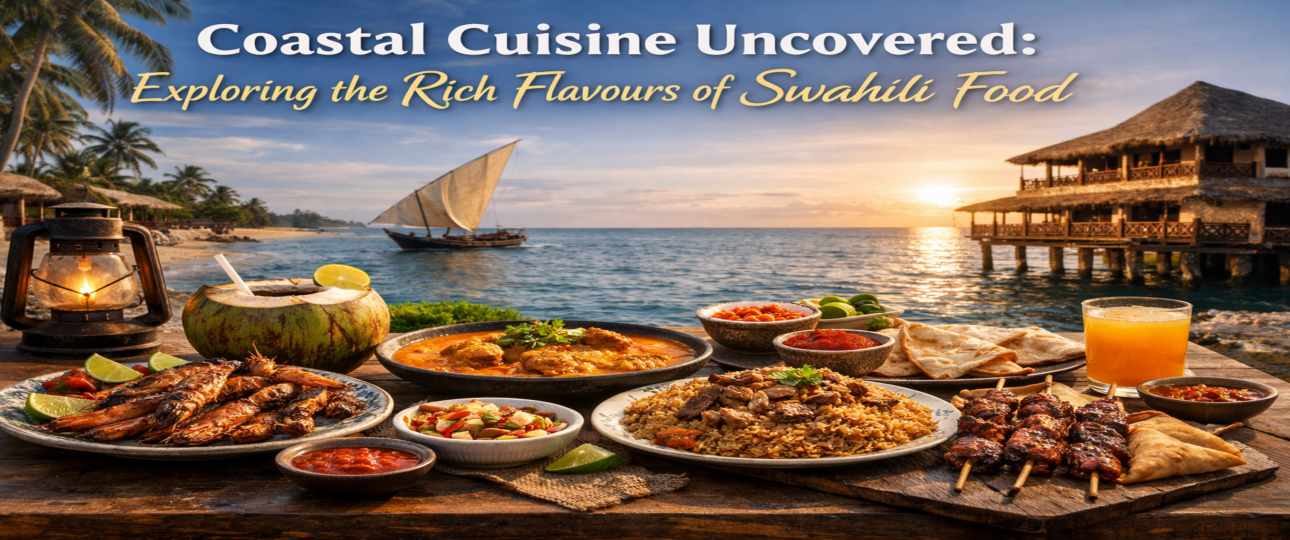
The pantry starts simple enough: rice, fresh fish and seafood (prawns, octopus, reef fish), coconut in all its forms (milk, cream, grated flesh, and madafu water), cassava and sweet potatoes, leafy greens, beans, and peas. Then the spices walk in like they own the place – cloves, cinnamon, cardamom, cumin, coriander, turmeric, black pepper, ginger – and suddenly your nose knows you’re on the coast.
Coconut is the quiet tyrant here. Coastal writers point out that it’s used in “most dishes”: wali wa nazi (coconut rice), mbaazi wa nazi (pigeon peas in coconut), coconut fish stews; even madafu, the young coconut water you sip from the shell, doubles as hydration and soft launch into coastal life. One essay calls coconut a local crop that binds celebratory dishes and everyday meals, making it a cultural marker as much as an ingredient.
Cooking methods echo that mix of comfort and drama: slow-stewed curries, seafood and meat grilled over open coals, deep-fried snacks like mandazi and viazi karai, and aromatics sautéed down into fragrant spice bases. The goal isn’t to burn your tongue off; it’s to build layers, like telling the same family story every year but adding more scandal each time.
And beneath the indulgence, Studio Emocje highlights omega-rich seafood, fiber from legumes and vegetables, and antioxidant-rich spices such as ginger, garlic, cloves, and cinnamon, which support digestion and reduce inflammation. Swahili food: comforting enough to feel sinful, nutrient-rich enough to impress your nutritionist.
Pilau and Biryani: The “Sacred” Grains
Let’s talk about the royalty: pilau and biryani. If you insult these dishes on the coast, you may need witness protection.
Pilau is spiced rice cooked in stock with cloves, cinnamon, cumin, and black pepper; writers and home cooks alike describe it as “sacred” at weddings and religious holidays, cooked in huge communal pots that smell like memory. Wanderlust Trails’ contemporary Swahili-food essay literally calls pilau and biryani “sacred dishes,” central to Eid and other celebrations, where every grain must be kissed by spice and broth. No pressure.
Biryani ya Pwani plays diva in a different way: rice and meat are cooked separately, then carefully layered with yogurt, tomatoes, fried onions, and complex spice mixes. Coastal hotels hype it as one of the “famous” Swahili showpieces, the kind of dish that arrives at the table and makes everyone sit up a little straighter.
Historians point out that rice dishes like pilau and biryani grew out of centuries of interaction with Persian and Indian traders, who brought techniques and spices that fused with Swahili tastes. When you spoon up pilau, you’re eating a thousand years of negotiation, love, trade, and a very serious argument about whose grandmother makes it “properly.”
Samaki wa Kupaka: Fish Painted in Poetry
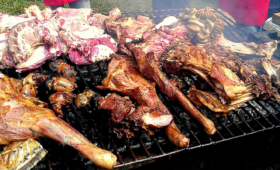
Now we step to the grill. The smoke curls around you, soft and insistent.
Samaki wa kupaka literally means “painted fish” – fish grilled, then slathered with a coconut-based sauce that Wanderlust Trails describes as smoky from char, creamy from coconut, bright with citrus, and gently warm with spice. It’s often singled out as one of the most “definitive and craveable” Swahili coastal plates: a dish that tastes like sea breeze, charcoal, and someone’s well-kept secret.
That coconut-citrus-chili combination is the coast in shorthand: local catch, local coconut, imported spice routes all converging on one humble fish. It’s the kind of meal that makes you briefly consider forsaking inland life forever. Until you remember how expensive beachfront rent is.
Mombasa After Dark: Street Snacks and Small Revolutions
Let’s wander into Mombasa, where the streets hum, the tuk-tuks complain, and the vendors absolutely do not care about your diet plan.
A 2026 study on Mombasa’s street food culture, published on The Conversation, notes that by the 1930s, most residents were already buying almost all their food in cash from small grocers and vendors, turning the city into an urban foodscape of ready-to-eat snacks, tea, and cooked meals. In other words, meal prep died here long before Instagram tried to resurrect it.
HelloMombasa now describes Old Town as a “living pantry” of Swahili cuisine, pointing travelers to family-run eateries and narrow alleys where biryani, viazi karai, mkate wa sinia, and fried cassava await along the seafront promenades, such as Mama Ngina Waterfront.
Contemporary reporting from Watamu talks about a rise in “food tourism”: tasting events, street-food evenings, and Swahili eateries “full at all hours” serving coconut shrimp, stewed octopus, chapati, samosa, pilau – often at prices that feel almost suspiciously kind.
The snack lineup reads like a poem: viazi karai (battered, spiced potatoes spritzed with lemon and chili), bhajias, fried cassava, samosas, mahamri (cardamom-scented doughnuts enriched with coconut milk), mkate wa sinia (fermented rice cake), mandazi. You wash it down with black spiced tea or madafu and tell yourself you’ll eat a salad tomorrow. You won’t. But it’s a nice thought.
Coconut, Memory, and the Politics of the Plate
Food here is not neutral. It remembers things the history books like to whisper.
In “Food Culture at the Kenyan Coast,” writers at The Elephant note that coconuts are “a local crop used in most dishes,” their water hydrating beach-goers while their milk binds everyday stews and festive meals. Coconut becomes a symbol: of the coast itself, of continuity, of the way Swahili communities have held onto culinary knowledge in spite of modernization.
Many recipes are transmitted orally, cooks “relying on memory and instinct” rather than written measurements, which makes each family’s pilau, each neighbor’s curry, stubbornly unique. It’s beautiful, yes, but also complicated: cloves from Zanzibar are tied to the history of plantations and enslaved labor; fast food chains struggle to displace local vendors because the community trusts its own foodways more than imported franchises.
Colonialism may have redrawn maps, but the coast still lines up for mahamri and chai at dawn, conducting quiet resistance via breakfast.
From Street Stall to White Tablecloth
Now let’s talk glow-up.
Tourism boards say Swahili coastal food – especially seafood, coconuts, pilau, biryani, and spiced teas – is a major culinary draw for visitors, increasingly woven into safari packages and beach-resort marketing.
Chefs across Africa are even elevating pilau, samaki wa kupaka, and coconut curries onto tasting menus, applying the same precision usually reserved for French or Italian plates to reclaim African culinary heritage.
Kenya’s appearances at international gastronomy events are being framed around its “multicultural food landscape—from coastal Swahili dishes to Afro-fusion,” with culinary educators arguing that the country is well-positioned to attract visitors from Europe and Asia who increasingly seek local flavors rather than generic “continental” buffets.
In the diaspora, an interview with Faiza Muhambi on VoyageSTL talks about their kitchens “bringing tastes and flavors from home,” using food (and sometimes dance) as cultural ambassadors.
So yes, the same viazi karai you eat off a grease-stained paper cone might show up on a white plate with a smear of aioli and a microgreen. Does it look slightly ridiculous? Absolutely. Does it still slap? Also yes.
Coastal Food as Self-Care (With Extra Spice)
If you’re wondering whether all this deliciousness can fit into a “healthy lifestyle,” the answer is: kind of beautifully, actually.
Studio Emocje describes typical coastal meals as “nutrient-rich,” thanks to combinations of vegetables, legumes, herbs, and spices, especially in coconut-based stews and leafy-green sides.
Regular use of fish and seafood means many plates are naturally high in protein and omega-rich fats, which are linked to potential cardiovascular benefits when paired with fats like coconut rather than heavily processed industrial oils.
Spices like ginger, garlic, cloves, and cinnamon get praise for supporting digestion, having anti-inflammatory properties, and helping regulate blood sugar. So yes, you might be eating a deep-fried mandazi at 10 p.m., but you’re also sipping antioxidant-rich chai and loading up on legumes and grilled fish. It’s chaos, but it’s balanced chaos.
Why the Swahili Coast Belongs on Your Plate
So, where does all of this leave you?
You’re looking at a cuisine that scholars describe as an “intricate amalgamation” and “unique cultural melting pot,” born from centuries of exchange and now standing at the crossroads of heritage, tourism, and creative reinvention. You have communal rituals like kisinia and Eid pilau that turn streets into open-air banquets. You have a pantry ruled by coconut, perfumed with cloves, softened by rice, sharpened by citrus, and chili.
You have Mombasa’s street vendors and Watamu’s pop-up food evenings showing how wage work and urban life pushed people from home kitchens into a living network of stalls, kiosks, and tiny eateries. You have chefs and restaurateurs—from Old Town to Nairobi to the diaspora—turning those same dishes into statements of identity, artistry, and quiet rebellion.