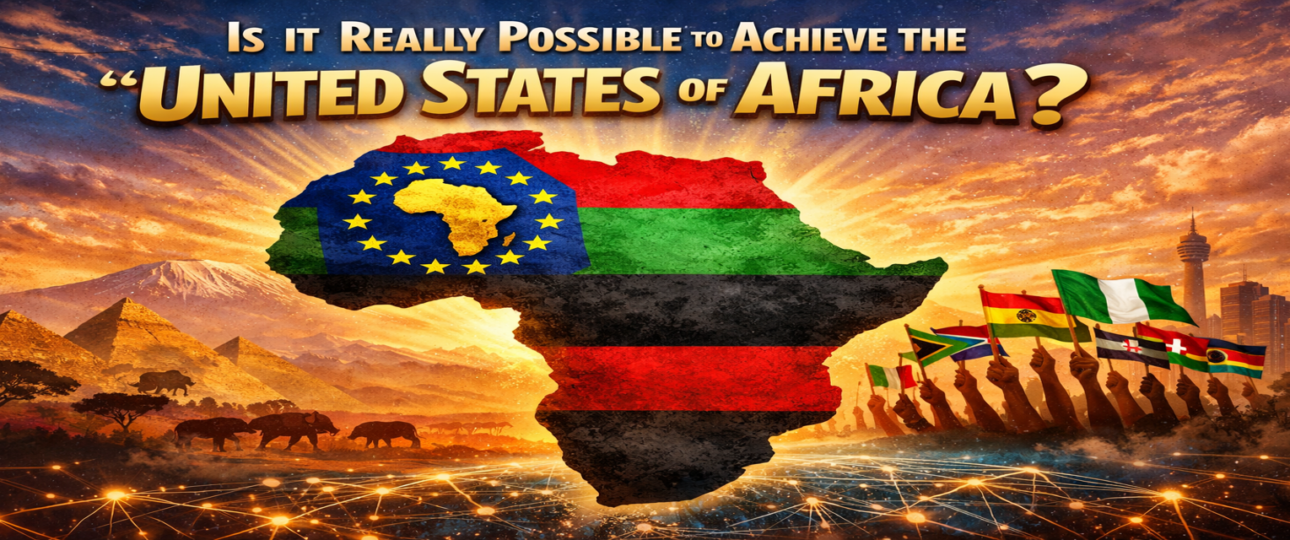
Imagine one passport, one currency, and one massive, 1.4-billion-strong community stretching from Cairo to Cape Town.
It’s the dream of a “United States of Africa,” a vision that’s been fueling poets and presidents for a century.
The “United States of Africa” is no longer just a romantic idea; it’s becoming a strategic economic necessity for a continent with a combined GDP of $3.4 trillion.
As UN Secretary-General António Guterres recently put it, Africa is an unstoppable force for the future—its rise must be undeniable. We’re now in the “Decade of Acceleration” (2024–2033), where big projects are finally hitting the ground. Intra-African trade rose to 14.9% in 2023 and is projected to increase by another 35% by 2045 as barriers fall.
Even our guests are feeling the shift, with new digital nomad permits in Kenya and Rwanda making it easier for us to work from anywhere.
The Poets and the Presidents: Where the Dream Started
The phrase “United States of Africa” actually started in a poem, not a boardroom. Back in 1924, Marcus Garvey wrote “Hail, United States of Africa,” a rallying cry for the diaspora to look back at their roots with pride. We often talk about Garvey’s legacy during our cultural tours because his words laid the emotional groundwork for everything that followed. He didn’t just want people to move; he wanted them to belong to a continent that could finally stand on its own two feet. This wasn’t just about poetry; it was about power and reclaiming an identity that had been suppressed for centuries.
By the 1950s, the dream moved from poetry to the messy world of post-colonial politics. Kwame Nkrumah, the first president of Ghana, became the face of this movement, famously declaring that “Africa must unite” or face certain failure. At The Walk Adventures, we find Nkrumah’s vision fascinating because he wasn’t just talking about a vague sense of brotherhood; he wanted a common government and a single army. He believed that as long as Africa was divided into small, vulnerable states, it would always be at the mercy of its former colonizers. His 1958 conference in Accra was the first time African leaders met on their own soil to discuss their shared future.
However, the road to unity was never going to be a straight line. Even back then, leaders were split into two camps: the “Casablanca Group,” who wanted union right now, and the “Monrovia Group,” who preferred a slow-and-steady approach. The Monrovia group eventually prevailed, leading to the formation of the Organization of African Unity (OAU), which focused more on protecting national sovereignty than on merging it. It was a necessary compromise, but it meant that the “United States of Africa” remained a distant, shimmering goal.
The Gaddafi Era: Gold Dinars and Bold Moves
In the early 2000s, the conversation around a unified Africa took a wild, high-stakes turn. Libya’s Muammar Gaddafi revived the idea with a level of intensity and bankroll that the continent hadn’t seen in years. He didn’t just want a union; he wanted a “Gold Dinar” currency and a continental military capable of rivaling the world’s superpowers. During his time as chairman of the African Union, he pushed other leaders hard, sometimes using his oil wealth to gain influence and support. It was a polarising era, but it forced the world to take African unity seriously again.
Many of the older guides we work with at The Walk Adventures remember the buzz during the 2009 AU summits. Gaddafi insisted that sovereign countries work toward the United States of Africa, as if it were a deadline that couldn’t be missed. He argued that a single currency would stabilize exchange rates and make trade between neighbors as easy as buying a coffee in your own hometown. While many leaders were intimidated by his methods, they couldn’t ignore the logic that a unified market of 1.4 billion people would be an economic juggernaut. His vision was radical, but it paved the way for the more structured plans we see today.
After Gaddafi’s fall in 2011, momentum for an immediate political union definitely slowed. But the “seed” he planted regarding economic sovereignty refused to die. Today, that energy has been channeled into the African Union’s “Agenda 2063,” a much more organized 50-year plan for transformation. We’ve noticed that the conversation has shifted from “Who will lead us?” to “How do we build the roads and rails to connect us?” It’s less about one man’s ego and more about a collective realization that unity is the only way to survive in a multipolar world.
Agenda 2063: The Blueprint for “The Africa We Want“
If you want to understand the future of the continent, you have to look at Agenda 2063. This isn’t just a boring policy document; it’s a detailed map for an integrated, peaceful, and prosperous Africa.
We’re currently in what experts call the “Decade of Acceleration” (2024–2033). This is the window where big dreams like the African Continental Free Trade Area (AfCFTA) are supposed to go from pilot projects to everyday reality. Our team is particularly excited about the goal of having the Integrated High-Speed Rail Network operational by 2033. Imagine a train that could whisk you from our base in Nairobi to a meeting in Addis Ababa in just a few hours. That kind of connectivity would change the game for businesses like ours and for every traveler exploring the continent.
One of the coolest parts of Agenda 2063 is the focus on human capital and the “youth bulge.“ Africa has the world’s youngest population, and the plan is to turn that energy into a “skills revolution.” We see this talent every day in the young tech-savvy guides and conservationists we partner with. By 2063, the goal is for 70% of high school graduates to attend university, with most pursuing science and technology. It’s a long-term play, but it’s the only way to ensure that the “United States of Africa” is built by Africans, for Africans.
The AfCFTA: Building the World’s Largest Free Trade Zone
While politicians talk about unity, the AfCFTA is actually making it happen in the marketplace. This agreement has connected 54 nations into a single market with a combined GDP of $3.4 trillion. For us at The Walk Adventures, this means fewer headaches when we move equipment or supplies across borders. In 2024, intra-African trade reached $220.3 billion, a 12.4% increase from the previous year. It’s a sign that African countries are finally starting to prioritize their neighbors over distant markets in Europe or Asia.
The real magic of the AfCFTA isn’t just in the trade numbers; it’s in its potential to reduce poverty. The World Bank thinks this initiative could lift 30 million people out of extreme poverty and boost incomes for another 70 million by 2035. We’ve seen how economic integration can transform small communities along our trekking routes. When a local farmer can sell their produce to a hotel across the border without getting stuck in red tape, the whole village thrives. It’s about creating resilient economic structures that can survive global shocks.
Of course, there’s still a massive “trade gap” that we need to close. Right now, we’re falling about $77 billion short of our full intra-trade potential. At The Walk Adventures, we know that infrastructure is the biggest bottleneck to closing that gap. If it’s cheaper to ship a container from Shanghai to Lagos than from Accra to Lagos, we have a problem. That’s why the AfCFTA isn’t just about tariffs; it’s about building the ports, roads, and digital systems that make trade actually work.
The shift toward industrialization is the next big frontier for the continent. Historically, Africa has exported raw materials and imported finished goods, which is a recipe for staying poor. We support the move toward value-added manufacturing, whether it’s processing coffee in Kenya or making gear in Ethiopia. The goal is for manufacturing to account for 50% of continental GDP by 2063. When we buy locally-made equipment for our treks, we’re not just being patriotic; we’re participating in the “United States of Africa” economic model.
Single African Air Transport Market (SAATM): Opening the Skies
If you’ve ever tried to fly between two African cities, you know how frustratingly expensive it can be. Sometimes it’s literally cheaper and faster to fly to Paris or Dubai for a layover than to go directly to a neighboring country. This is exactly what the Single African Air Transport Market (SAATM) aims to address. It’s a plan to liberalize the aviation sector, allowing African airlines to fly anywhere on the continent without restrictive bilateral agreements. At The Walk Adventures, we’re following this closely because lower airfares mean more people can experience the magic of our tours.
Currently, taxes and fees make up about 35–40% of the price of an airline ticket in Africa. That’s nearly double the global average of 20%, which is a huge barrier for the average traveler. We’ve seen some great progress recently, with ECOWAS deciding to abolish certain industry taxes and reduce passenger charges starting in 2026. When those costs come down, we expect to see a 30-40% reduction in fares, making regional travel much more accessible for everyone. It’s about making aviation an economic necessity rather than a luxury for the elite.
The infrastructure investment required is massive, but the payoff is even bigger. The African Union estimates we need between $25 and $30 billion over the next decade to modernize our airports and navigation systems. We’re seeing new “mega-airports” pop up, like the $3.8 billion Dr. António Agostinho Neto International Airport in Angola. These aren’t just vanity projects; they are strategic hubs that will connect Southern, Central, and East Africa in ways we never thought possible. For us at The Walk Adventures, these hubs are the starting points for a whole new generation of adventures.
Aviation isn’t just about moving people; it’s a critical part of the AfCFTA’s success. Fast and reliable cargo transport is essential for high-value goods like tech components and specialized equipment. When we can fly a team from Lagos to Nairobi for a team-building retreat as easily as a domestic hop, we’ll know the SAATM has truly arrived. It’s the difference between being a continent of neighbors and a continent of strangers.
The African Passport: Traveling Without Borders
The “Holy Grail” for most of us in the travel industry is the African Union Passport. Launched in 2016 for heads of state, the goal is to eventually roll this out to every citizen, allowing visa-free travel across all 55 member states. Right now, the reality is a bit more complicated, as many nations remain reluctant to fully open their borders. At The Walk Adventures, we’ve spent years navigating these hurdles, and we can tell you that a single passport would be a total game-changer for the safari industry. It would turn a trip to Africa from a logistical puzzle into a seamless experience.
Some countries are already leading the way and showing the rest of the continent how it’s done. Rwanda, Benin, The Gambia, Seychelles, and Ghana now offer visa-free entry to all African nationals. We’ve noticed a huge spike in interest for our Rwanda trekking packages ever since they liberalized their visa regime. It’s proof that when friction is removed, people will travel. Kenya has also made big moves with its new Electronic Travel Authorization (ETA) system, exempting citizens from 52 African countries from traditional visa processes.
The East African Tourist Visa (EATV) is the perfect “mini-model” of what the AU Passport could be. For just $100, travelers can explore Kenya, Uganda, and Rwanda on a single multiple-entry visa for up to 90 days. We use this visa for almost all of our multi-destination safaris because it’s so convenient and cost-effective. It’s a great example of how regional integration can happen even before the whole continent gets on board. The only downside is that it doesn’t yet include other EAC members, such as Tanzania or the DRC, though we’re hopeful that will change soon.
Digital transformation is helping bridge the gap while we wait for the physical passport. 31 countries now have e-visa portals, making it much easier to apply for travel authorization from the comfort of your home. At The Walk Adventures, we always tell our clients to check for these digital options because they’re usually faster and more transparent than the old-school methods. However, we have to be careful—sometimes “e-visas” can actually be more restrictive than the old “visa-on-arrival” systems. The goal for 2033 is widespread visa-free travel, and we’re keeping our fingers crossed that we hit that target.
Roads and Rails: The Physical Arteries of Unity
You can’t have a “United States of Africa” if you can’t drive or take a train between the states. That’s where the Programme for Infrastructure Development in Africa (PIDA) comes in, focusing on high-speed rail and trans-continental highways. Our guests at The Walk Adventures often tell us that the journey is just as important as the destination. Whether it’s the TAZARA railway linking Tanzania and Zambia or the new roads in the East African Community, these links are making the continent feel smaller and more connected. It’s about turning “separated nations” into “interconnected regions.“
The Lobito Corridor is one of the most exciting projects underway in Central and Southern Africa. It connects the copper-rich regions of Zambia and the DRC directly to the Atlantic port in Angola, significantly reducing transport costs and times. We see these corridors as more than just trade routes; they’re paths for cultural exchange and new tourism opportunities. When a new rail line opens, it brings life to towns that were once isolated. It’s the physical manifestation of the Pan-African dream.
Energy is the silent partner in all of this physical integration. We can’t run high-speed trains or modern factories without power, and currently, half the population still lacks access to it. Projects like the Grand Inga Dam in the DRC have the potential to light up the whole continent and even export clean energy to Europe. At The Walk Adventures, we’re huge fans of renewable energy—it’s why we love seeing solar and wind projects popping up along our safari routes. The vision for 2063 is an Africa powered by its own sun and rivers.
Of course, maintenance is just as important as building new things. We’ve all seen “white elephant” projects that fall apart after a few years because nobody took care of them. That’s why the African Union is focusing on harmonizing transport and energy standards and regulations. If a train can’t cross a border because the tracks are a different width, the integration fails. It’s the “nitty-gritty” details that our team at The Walk Adventures handles for your trips that the AU is now trying to handle for the whole continent.
Sovereignty and the “Borders of the Mind“
One of the biggest obstacles to a unified Africa is something you can’t see on a map: the concept of national sovereignty. Many leaders are understandably hesitant to give up the power they fought so hard to win during the independence struggle. At The Walk Adventures, we respect the unique identity of every country we visit, and we know that “being African” means different things in Nairobi than it does in Lagos. Critics of a “United States of Africa” argue that forced unification could actually lead to more conflict if distinct cultural values aren’t respected. It’s a delicate balance between unity and autonomy.
The legacy of the 1884 Berlin Conference, where European powers carved up the continent, still haunts us today. These arbitrary borders often split ethnic groups in two or force rival groups into the same country. Some argue that the “Berlinist state” must be transcended to achieve true peace, while others fear that redrawing borders now would be a recipe for chaos. It’s perhaps the most complex puzzle the AU has to solve.
Economic sovereignty is another huge piece of the puzzle, especially when it comes to debt. Right now, Africa is spending $163 billion a year just to service its debt—that’s three times more than it was spending in 2010. This “debt trap” makes it incredibly hard for countries to invest in the integration projects that would eventually make them more self-sufficient. When African countries have to choose between paying a foreign creditor and providing healthcare, integration often takes a backseat. It’s a systemic issue that requires a complete overhaul of the global financial architecture.
Language is another practical barrier we often forget until we try to order lunch in a different region. With over 2,000 languages spoken across the continent, communication is a constant challenge. At The Walk Adventures, we’re lucky to have multilingual guides, but on a continental scale, we need more “cross-border knowledge sharing.” Whether it’s using English, French, Swahili, or Arabic, finding common ways to talk to each other is the only way to build a shared future. It’s about breaking down the “borders of the mind” just as much as the borders of the land.
The Role of Tourism: Bringing the Dream to Life
We truly believe that tourism is the “secret sauce” for African unity. When you travel, you aren’t just a consumer; you’re an ambassador. At The Walk Adventures, we see how a single hike can change a person’s perspective on a whole region. By bringing people together—whether it’s locals from different tribes or international travelers from across the globe—we are creating the “meaningful connections” that Agenda 2063 talks about. Tourism is the glue that turns a collection of countries into a community.
The “Digital Nomad” trend is a perfect example of how the continent is becoming more integrated at a grassroots level. Cities like Cape Town and Nairobi are becoming global hubs for remote workers who want to experience the African lifestyle while staying connected to the world. We’ve started tailoring some of our “nature walks” and “safari excursions” to these nomads, offering them a chance to “reset their souls” without missing a Zoom call. It’s a new kind of integration that isn’t driven by politicians, but by people choosing to live and work across borders.
We’re also seeing a massive rise in “intra-African tourism.“ More and more Nigerians are visiting Kenya, and more Kenyans are exploring the beaches of Zanzibar or the mountains of Rwanda. At The Walk Adventures, we love this trend because it means we’re finally starting to discover our own backyard. The AfCFTA and SAATM are going to make this even easier, turning the continent into a single, massive playground for a new generation of African adventurers. It’s about building a “continental consciousness.“
Sustainable tourism is the only way to ensure that this growth doesn’t destroy what makes Africa special. We are dedicated to responsible travel that benefits local communities and preserves the environment. As the continent unites, we have to make sure we don’t fall into the trap of “over-tourism” or environmental degradation. The goal of Agenda 2063 is a “prosperous Africa based on inclusive growth,” and for us, that means making sure the lions, the forests, and the local cultures are still here for the next 100 years.
The Financial Architecture: Paying for the Dream
Let’s be real: you can’t build a United States of Africa on pocket change. The funding needed for the 2063 flagship projects is astronomical, and the old reliance on foreign aid just isn’t working anymore. Most historical donors have cut their budgets, and for many African countries, aid now represents less than 1% of their income. This is actually a good thing! It’s a “wake-up call” to take full ownership of our development and find “solutions from within.” We have the resources; we just need to manage them better.
Africa is actually a “net creditor” to the world when you factor in our natural resources and the illicit financial flows that leave the continent. We have 30% of the world’s mineral reserves and a large share of the critical minerals needed for the “green revolution,” such as cobalt and lithium. The challenge is to move from being an “extractive economy” to a “value-added economy.” Instead of just shipping raw ore to China or Europe, we need to be the ones making the batteries and the electric cars right here on the continent.
African investors also need to put their money where their mouth is. Currently, only a small portion of foreign direct investment (FDI) in Africa comes from African investors. We can’t expect the rest of the world to believe in our future if we aren’t willing to bet on ourselves. That’s why we’re seeing a big push to redirect African pension funds and sovereign wealth funds toward local and regional infrastructure.
The “Africa Premium” is a real tax on our growth. Because global markets perceive Africa as “risky,” our countries often have to pay interest rates that are much higher than those in Asia or Latin America—even when the actual default rates are lower here. This is why we need our own “African-led financing mechanisms” that actually understand our context. The African Development Bank and Afreximbank are leading the charge, but we need even more coordination to truly assert our economic sovereignty. It’s about building a financial system that works for us, not against us.
Peace and Security: Silencing the Guns
You can’t have a united continent if people don’t feel safe. “Silencing the Guns” was one of the first major goals of Agenda 2063, and while we’ve missed the initial deadlines, the commitment remains. We’ve seen how conflict can shut down tourism in an instant, and we know that peace is the foundation for everything else we want to achieve. Since 2020, armed conflict has increased by 45% in some regions, showing just how much work we still have to do. It’s a sobering reminder that unity isn’t just about trade; it’s about human life.
The African Standby Force (ASF) is intended to be the continent’s rapid-response team for crises, but it remains underdeveloped. Right now, we still rely too much on external forces for peacekeeping, which can sometimes create more complications than it solves. Building a “common African defense policy” is one of the guiding principles of the AU Constitutive Act. It’s about taking responsibility for our own security and ensuring that African-led solutions are the first line of defense against instability.
Conflict often has deep-rooted causes, such as climate change, resource mismanagement, and a lack of opportunities for youth. In the Sahel, for example, the shrinking of Lake Chad has driven competition for land and water, leading to violence. When people have jobs, clean water, and a stake in the future, they are much less likely to pick up a gun. Peacebuilding has to be about more than just soldiers; it’s about “justice and the rule of law.“
We also have to deal with the “unconstitutional changes of government” that have plagued some regions lately. The AU has a “non-indifference” policy, which means it can suspend members that experience a coup. However, enforcement is often inconsistent, and we need stronger political will to hold each other accountable. As we often say on our team-building retreats, “a group is only as strong as its weakest link.” For the United States of Africa to work, every state has to commit to the basic principles of democracy and human rights.
The “Silicon Savannah” and the Digital Future
Technology is the ultimate border-buster. While it might take years to build a physical highway, a digital connection can happen in an instant. Africa’s “Internet economy” was projected to reach $180 billion by 2025, which is about 5.2% of our total GDP. We’ve seen this transformation firsthand with mobile money—65% of all mobile money processed globally happens right here in Africa. This technological readiness is the secret weapon that will make the “United States of Africa” possible.
Digitalization isn’t just about apps; it’s about making our governments more efficient and transparent. From e-visas to digital tax systems, technology is helping to eliminate the “friction” that has traditionally held back intra-African trade. At The Walk Adventures, we use these tools every day to manage bookings, coordinate with guides, and share our stories with the world. The goal is to create a “Pan-African E-Network” that connects every school, hospital, and business on the continent.
We also have to be careful about “digital re-colonization.“ We don’t want to just be consumers of Western or Chinese tech; we need to be the innovators. That’s why we’re seeing a surge in “Silicon Savannah” hubs in places like Nairobi and Lagos, where young African developers are creating solutions for African problems. Whether it’s agritech for our farmers or fintech for our traders, the future of the continent is being written in code. The “United States of Africa” will be a digital-first union.
Affordable connectivity is the next big challenge. While we’ve made huge strides, high data costs still exclude too many people from the digital revolution. We’re seeing more investment in “intra-African broadband terrestrial infrastructure” to bring down these costs. When every child in a remote village has access to the same information as a student in New York or London, we’ll see a literal explosion of talent. Technology is the bridge that will finally connect the poets of 1924 with the presidents of 2063.
Is the “United States of Africa” Really Possible?
So, after all the data and the history, what’s the verdict? Is it actually possible to achieve the “United States of Africa?” The honest answer is that it’s already happening—just not in the way we expected. We might not have a single capital city or a single president anytime soon, but we are becoming “united” through our markets, our flight paths, and our shared digital spaces. The “United States of Africa” is a process, not a destination.
At The Walk Adventures, we see this process every time we lead a group across a border. We see the challenges, sure, but we also see the incredible resilience and the shared spirit of “Ubuntu“—the idea that “I am because we are.” We are reminded that our diversity is our greatest strength, not a reason for division. The dream of Nkrumah and Garvey is alive in every young entrepreneur and every traveler who chooses to see Africa for themselves.
The next decade will be the true test. If we can successfully implement the AfCFTA, open our skies through SAATM, and start moving toward a common passport, the “United States of Africa” will become an unstoppable force. It’s going to take “visionary leadership” and a whole lot of hard work, but the potential payoff—a $3.4 trillion economy and a voice that the world can’t ignore—is worth the effort. We’re excited to be part of this journey, and we can’t wait to see where the path leads next.
In the words of one of our favorite African proverbs, “If you want to go fast, go alone; if you want to go far, go together.” The view from the top is always better when you’re with friends. The United States of Africa is the ultimate “group trek,” and while the trail might be steep, the destination is going to be spectacular. So, pack your bags, grab your boots, and let’s make history together.
Key Takeaway
Achieving a full “United States of Africa” remains a long-term strategic goal, but the continent is currently hitting a “Decade of Acceleration” (2024-2033) where economic and physical integration—specifically the AfCFTA ($220B trade) and SAATM (30-40% lower fares)—are turning the vision into a daily reality for businesses and travelers alike.
For companies like The Walk Adventures, this shift means moving away from 54 fragmented markets toward a single, $3.4 trillion destination. While sovereignty and debt are still major hurdles, the rising “youth bulge” and digital revolution are building a borderless Africa from the ground up, making the dream of a unified continent more inevitable than ever.